What is the difference between the 18th Edition course and Inspection and Testing?
The 18th Edition course and Inspection and Testing cover different parts of electrical competence. The 18th Edition, usually the City & Guilds 2382-22, teaches the wiring regulations in BS 7671:2018, whereas Inspection and Testing, usually City & Guilds 2391-52, focuses on verifying electrical installations through inspection, testing, and certification. One does not replace the other, and many electricians need both at different points in their working life.
Anyone comparing 18th Edition vs Inspection and Testing is usually trying to answer a practical question: do I need regulations knowledge, or do I need the qualification that proves I can inspect, test, and complete the paperwork correctly?
Here's What We Have Covered In This Article
Direct Answer: Key Differences Between the 18th Edition Course and Inspection and Testing
The simplest way to separate them is by purpose. The 18th Edition is about knowing the rules. Inspection and Testing is about applying checks to electrical work and recording the results properly.
- 18th Edition: covers wiring regulations, selection and erection principles, protection, and compliance with BS 7671:2018
- Inspection and Testing 2391-52: covers initial verification, periodic inspection, test procedures, results, and certification
- 18th Edition assessment: usually a multiple-choice exam
- 2391-52 assessment: includes written elements and practical assessment
A common misunderstanding causes a lot of confusion. Passing the BS 7671 course does not mean someone is qualified to carry out formal inspection and testing duties in the way employers, clients, or schemes may expect. By the same token, 2391-52 assumes a solid grasp of the regulations, because testing decisions make little sense without that reference point.
Pro Tip 1: If you struggle finding your way around BS 7671, practise quick referencing with the book before your 18th Edition exam.
Who Needs Each Qualification? Matching Courses to Career Stages
Career stage matters as much as job title. A new entrant, an improver, and an experienced electrician may all need different qualifications even if they work on similar sites.
Someone starting out in electrical installations will often meet the 18th Edition early because employers want current wiring regulations knowledge. That applies whether the person is working on domestic jobs, commercial fit-outs, or industrial projects. The course gives a baseline for safe and compliant practice, and it often appears alongside broader electrical qualifications such as the Level 3 Technical Occupational Entry Diploma or an NVQ route.
By comparison, Inspection and Testing tends to suit people who already install electrical systems and now need to verify their own work or take on more responsibility. An electrician carrying out new installations, additions, alterations, or condition reporting may be expected to understand dead tests, live tests, fault identification, and certification. In that setting, 2391-52 becomes highly relevant.
Typical situations
If you are a career starter, the 18th Edition is often one of the first short courses to consider. It supports employability, shows current knowledge of wiring regulations, and fits naturally into a longer training route.
For an experienced installer, Inspection and Testing may become the next logical step once day-to-day work includes commissioning circuits, completing certificates, or signing off work carried out on site.
Employers also look at these qualifications differently. Some job roles simply ask for the 18th Edition because it shows regulations awareness. Others specify Inspection and Testing where the worker is expected to verify installations, diagnose issues, or produce formal documentation.
JIB grading and employer requirements do not always mirror each other exactly, so readers should treat job adverts and grading criteria as separate checks. A contractor may want both qualifications even where one is technically the starting point.
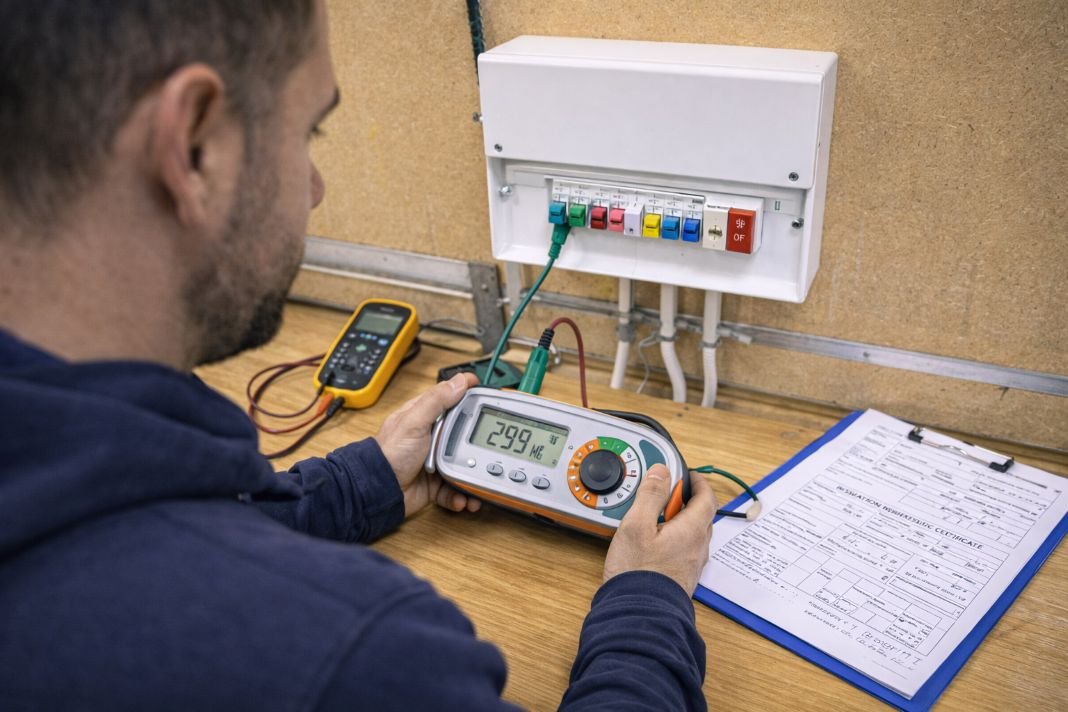
AI image of electrician performing insulation test in workshop
Pro Tip 2: For Inspection and Testing, simulate assessment conditions by running full test sequences and filling in real certification paperwork.
Course Content and Assessment: What’s Involved in Each?
Although both sit under the umbrella of electrical qualifications, the learning experience is quite different. One is mainly regulations based. The other moves into procedure, measurement, and judgement.
At MOS Training Centre in Loughton, Essex, City & Guilds electrical courses are delivered through an in-person training and exam setting, which suits learners who want a clear structure and direct support on assessment days.
18th Edition course content
The 18th Edition course concentrates on BS 7671:2018, known across the trade as the wiring regulations. Learners work through how the regulations are organised, how to use the book, and how to interpret requirements relevant to installation work.
Key areas usually include:
- scope and purpose of the regulations
- protection for safety
- selection and erection of equipment
- inspection requirements within the regulations framework
- special installations or locations
- how to reference BS 7671 quickly in an exam
Assessment is generally an online multiple-choice exam at an approved exam centre. Success depends less on practical skill and more on reading accuracy, book use, and understanding how the regulations are structured. Many capable electricians find that the main challenge is speed and precision under exam conditions, especially if they have practical experience but limited recent study practice.
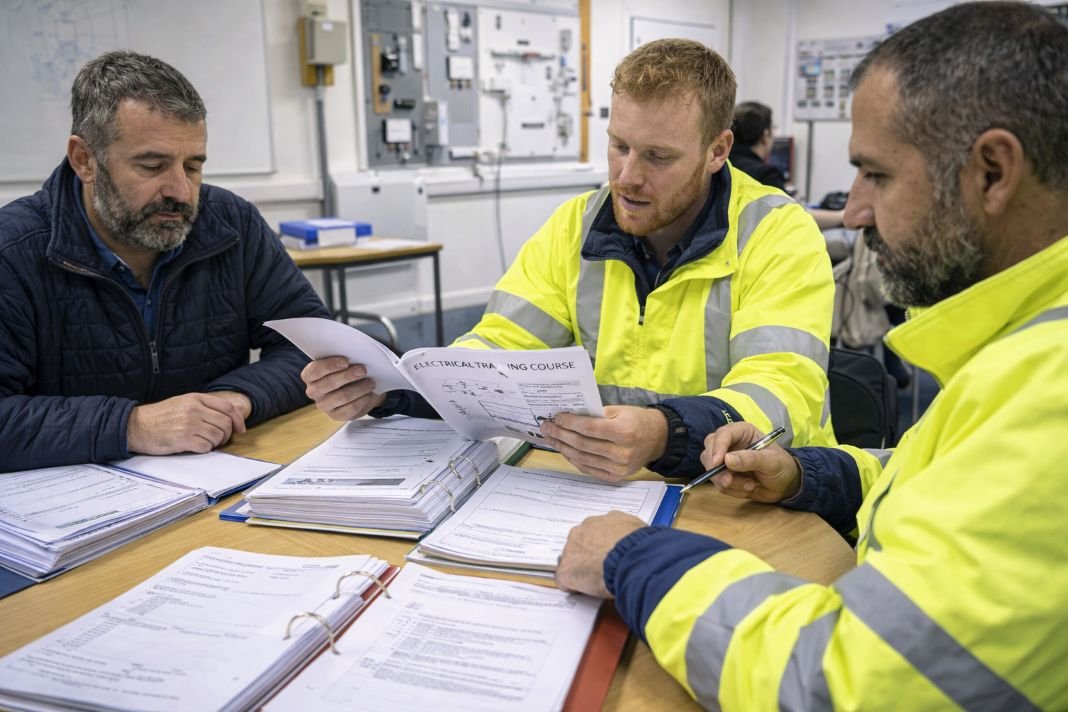
AI image of learning documentation and students in classroom
Inspection and Testing 2391-52 content
Inspection and Testing goes further into verifying electrical installations. Learners cover the sequence of checks, safe isolation principles, test methods, acceptable results, fault finding logic, and the correct use of certification.
The course typically includes initial verification, periodic inspection, test instruments, continuity, insulation resistance, polarity, earth fault loop impedance, and reading results in context. Written knowledge matters here, but practical competence matters too because the qualification asks the learner to perform tasks and record them correctly.
Assessment usually includes both theory and practical elements. That format changes the preparation needed. A candidate must revise procedures, understand the reasons behind each test, and stay calm while carrying out the sequence accurately in front of an assessor.
Course duration varies by provider and learner background, yet the shape of the two courses stays fairly consistent. The 18th Edition is usually shorter and more exam focused. Inspection and Testing often needs more preparation because learners are judged on method as well as knowledge, which becomes obvious the moment the practical assessment starts.
What Do These Qualifications Lead To? Cards, Roles, and Progression
Electrical qualifications matter because they connect directly to the kind of work a person can realistically take on. They also affect how credible a worker looks to employers, principal contractors, and schemes that expect current evidence of competence.
The 18th Edition can support access to many electrical roles because current wiring regulations knowledge is widely expected. It is often treated as part of the standard package for electricians and electrical improvers working on installations in domestic, commercial, or industrial settings. On its own, though, it does not prove that someone can inspect and test to the standard required for formal certification.
Inspection and Testing 2391-52 has a different effect. It supports roles where the electrician is responsible for verification, testing procedures, and paperwork. That can matter for those carrying out initial verification on new work, periodic inspection work, or testing linked to maintenance and fault diagnosis.
A few progression points are worth separating:
- The 18th Edition supports up-to-date regulations knowledge and is often expected across electrical jobs.
- Inspection and Testing supports work that involves formal checking, results interpretation, and certification.
- Combined with broader qualifications such as an NVQ and relevant experience, these courses can strengthen a route toward JIB recognition or better access to skilled site roles.
CSCS card and JIB requirements can vary by employer, scheme, and contract. Some sites focus on occupation and card type. Others look more closely at the full qualification history behind the applicant. In practice, an electrician with current wiring regulations knowledge and a recognised testing qualification often has a stronger case for roles that involve independence, sign-off duties, or higher trust on site.
Common Misconceptions and Mistakes: Avoiding Pitfalls
A lot of wasted time in electrical training comes from choosing a course based on hearsay. The names sound related, so people often assume the content overlaps more than it actually does.
- Myth: The 18th Edition is a practical electrical course. Fact: It is a regulations course. It supports compliance knowledge, but it does not assess installation skill in the same way as an NVQ or practical testing qualification.
- Myth: Inspection and Testing is only for senior electricians. Fact: It is more advanced than the 18th Edition in application, yet many working electricians take it once their job starts involving verification and certification.
- Mistake: Booking 2391-52 without being comfortable with BS 7671. A learner who struggles to use the wiring regulations book may find the testing decisions much harder to justify in both written and practical assessments.
- Mistake: Assuming one course automatically covers a client or employer requirement. Some employers ask for current 18th Edition as a baseline. Others also expect testing qualifications, inspection experience, or a full NVQ pathway.
- Mistake: Relying on an outdated qualification without checking current expectations. Electrical standards, contract requirements, and scheme expectations change over time, so old certificates do not always answer present-day job demands.
One of the most expensive errors is taking a qualification that sounds impressive but does not match the work being done. A domestic installer focused on current regulations may need the 18th Edition first. An electrician expected to issue certificates after testing new circuits faces a different requirement altogether.
Enrol on Inspection and Testing 2391-52
Advance your skills with Inspection and Testing at MOS Training Centre and verify your competence for new responsibilities.
UK Industry Context: Why These Qualifications Matter Now
The UK construction industry and electrical sector continue to face skills pressure, and that has practical consequences for workers on the ground. Employers need people who can show current competence, read the regulations properly, and carry out verification to an acceptable standard.
Demand for electricians is tied to more than traditional installation work. Renewable energy projects, EV charging, refurbishment, compliance checks, and ongoing maintenance all increase the value of current electrical qualifications. A worker who understands BS 7671 and can test and certify accurately is easier to place on a wider range of jobs.
Site standards have also become tighter. Main contractors, clients, and subcontractors pay closer attention to qualification evidence, particularly where safety, sign-off, and compliance records are involved. That does not mean every electrician needs every short course straight away, although it does mean qualification gaps become more visible over time.
MOS Training Centre delivers City & Guilds electrical qualifications from its Loughton centre, serving learners from Essex, London, and further afield. That local access matters for people who need an approved exam setting without building travel into every working week.
Industry change rarely arrives in one dramatic moment. It shows up in job adverts that ask for current regs, in contracts that require proper certification, and in the steady rise of work linked to modern electrical systems such as EV infrastructure.
Final Insight: Choosing the Right Path with Confidence
Choosing between the 18th Edition and Inspection and Testing becomes easier once the job outcome is clear. If the main need is current knowledge of wiring regulations, start with the 18th Edition. If the role involves verifying installations, carrying out tests, and completing certificates, Inspection and Testing moves into focus.
A sensible way to think about the decision is this:
- choose the 18th Edition for regulations knowledge and compliance awareness
- choose 2391-52 for inspection, testing, and certification responsibilities
- choose both over time if your work is moving toward fuller electrical competence and wider responsibility
No qualification solves every need on its own. Electrical careers usually build in layers, with regulations knowledge, practical ability, workplace evidence, and testing competence each playing a different part. Readers who match the course to the actual work they do, or plan to do next, usually make the soundest decision.