Can you qualify as an electrician without an apprenticeship?
Yes, you can become a qualified electrician without an apprenticeship in the UK. The usual alternatives are a classroom-based technical route through City & Guilds or EAL qualifications, followed by workplace assessment, or an experienced worker route if you already carry out electrical work and need formal recognition.
A traditional apprenticeship combines paid work and training from the start. A non-apprenticeship route usually separates those stages. You build technical knowledge through study, then prove competence through practical assessment and an NVQ, which stands for National Vocational Qualification. For many adults, career changers, and experienced workers, that route is realistic, recognised, and widely used.
Here's What We Have Covered In This Article
Who Is the Non-Apprenticeship Route For?
Non-apprenticeship electrician training suits people whose work, age, or finances make a standard apprenticeship hard to fit around life. It also suits workers who already have hands-on experience but do not yet hold the qualification employers, the JIB, or site rules may expect.
Career changers often take this path because they need flexible study and a clear route into the trade. Someone moving from maintenance, telecoms, facilities, or another practical job may already feel comfortable with tools, site routines, and health and safety.
Mature learners often prefer direct entry because they cannot start again on apprentice pay. Evening study, part-time learning, and staged qualifications can fit around current employment better than a traditional four-year structure.
Experienced electrical workers form another large group. Some have spent years assisting electricians, carrying out installations under supervision, or working in related roles, yet still lack the formal qualification route linked to industry recognition. An experienced worker electrician route can bridge that gap if the person already meets the practical standard.
Employers also use these routes to upskill staff. A contractor may have competent workers who need an NVQ electrician pathway to support JIB grading, card applications, or contract requirements on commercial sites.
Pro Tip 1: Before enrolling, gather detailed records of your electrical site experience to streamline the portfolio process.
Comparing the Main Qualification Routes (NVQ, City & Guilds, EAL)
People often compare qualifications as if they all do the same job. They do not. Some prove technical knowledge, some prove workplace competence, and some add specialist areas such as inspection, testing, or building regulations.
- City & Guilds technical courses These focus on the theory and practical training needed to work in electrical installation. A common direct-entry option is the Level 3 Technical Occupational Entry in Electrical Installations (2366-03), priced at £2,560. This route suits new entrants who need structured training before they can move into site-based work.
- NVQ-based workplace assessment An NVQ is assessed through evidence of real work rather than classroom exams alone. For electricians, the Level 3 NVQ Diploma in Electrotechnical Technology (2357) is commonly used to show occupational competence. Course pricing is listed at £1,600. This route suits people already working in the trade and able to gather site evidence.
- Experienced worker route The City & Guilds Electrotechnical Experienced Worker Qualification (2346-03), priced at £1,600, is aimed at workers with substantial industry experience who need to convert that background into a recognised qualification pathway. It is not an entry-level course. It expects existing competence and suitable workplace evidence.
EAL qualifications also sit alongside City & Guilds in specialist areas. The EAL Level 3 Award in Building Regulations for Electrical Installations in Dwellings supports work linked to domestic compliance, and the EAL PAT Testing qualification covers in-service inspection and testing of electrical equipment.
MOS Training Centre delivers City & Guilds electrical qualifications from its Loughton, Essex centre, which means that learners based in London and Essex can access in-person assessment and exams without using an apprenticeship model.
Recognition depends on the qualification purpose. A technical diploma builds knowledge. An NVQ confirms competence in the workplace. The 18th Edition, formally BS 7671:2018, shows current knowledge of wiring regulations. The right route usually combines more than one of these elements, especially for anyone aiming for JIB recognition or wider job access.
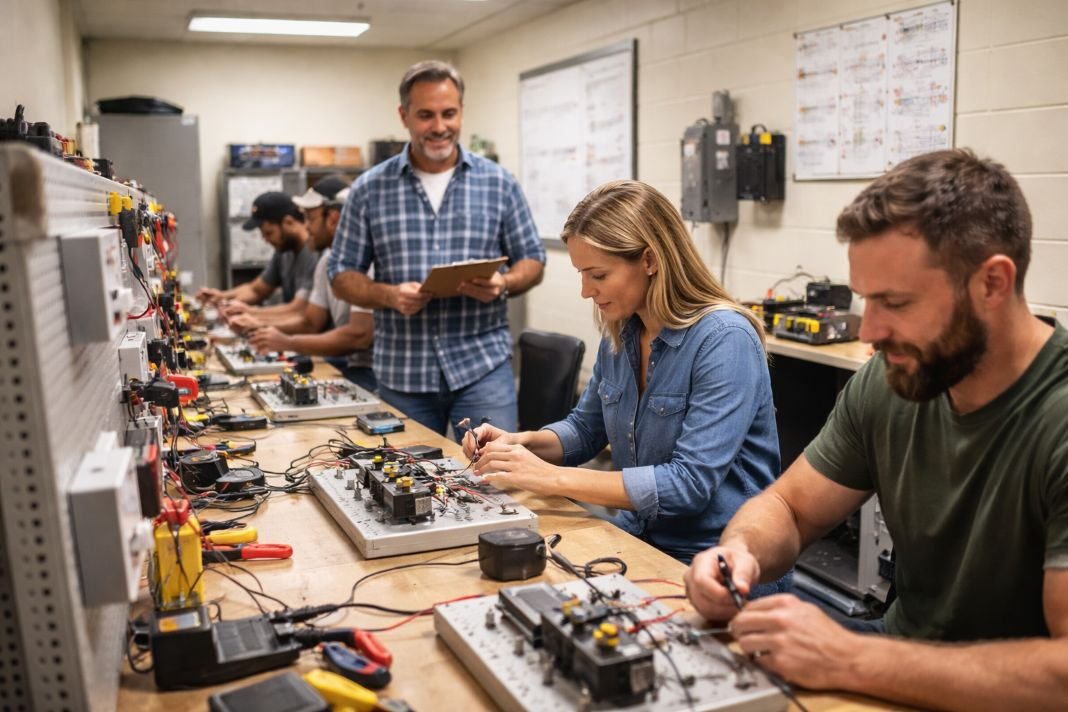
AI photo of electrical training in progress
Pro Tip 2: Check official JIB or ECS requirements to ensure your chosen qualification route provides the correct access for your intended job.
What’s Involved: Course Content, Assessment, and Duration
Most non-apprenticeship routes involve both theory and practice. Learners usually study electrical principles, installation methods, inspection basics, fault finding, safe isolation, and current wiring regulations. After that, workplace competence has to be evidenced if the route leads to a full occupational outcome.
A simple way to picture the process is this:
- Build technical knowledge through a course such as 2366-03.
- Gain site or workplace experience under suitable supervision.
- Complete a competence-based qualification, often including portfolio evidence and observation.
- Add regulation or testing qualifications where the role requires them, such as 18th Edition or 2391.
Portfolio evidence usually includes job sheets, photographs, witness testimony, risk assessments, method statements, and records of completed work. An on-site assessor reviews that evidence and checks whether the work matches the required standard. That is what people mean by competence assessment.
Timelines vary. A career starter taking the technical route first will usually need longer because they must study, gain experience, and then complete workplace assessment. An experienced worker may move faster if the evidence already exists and the daily job role covers the required tasks.
Preparation matters. Anyone considering an NVQ electrician route needs regular access to suitable electrical work. A person who only carries out very narrow tasks, such as basic maintenance or mate duties, may struggle to gather enough varied evidence for the full standard.
Specialist courses add another layer. The 18th Edition course, priced at £392, focuses on wiring regulations and exam preparation. City & Guilds 2391-52, priced at £1,200, covers initial and periodic inspection and testing, which is useful for electricians moving into testing work or roles with broader responsibility.

AI image of construction site job documentation display
What These Qualifications Lead To: Jobs, Cards, and Career Progression
Qualifications matter because they connect to real work options. A recognised electrical pathway can support access to installation roles, maintenance work, site-based positions, and later specialisms.
Common outcomes include:
- electrical installer
- installation electrician
- electrical improver progressing into a qualified role
- maintenance electrician
- testing and inspection work, if supported by the right qualification set
- domestic electrical work, including compliance-focused roles
Card and grading outcomes depend on the exact qualification combination and your work history. The CSCS Card, or Construction Skills Certification Scheme card, is used across UK sites, although electrical workers may also need routes linked to ECS arrangements depending on the employer or project. JIB grading also depends on recognised qualifications and practical competence, so readers should always match their chosen route to the card or grade they ultimately need.
Further progression is common once the core route is in place. An electrician with the NVQ, current 18th Edition knowledge, and inspection and testing qualifications may move into a wider range of jobs. Some go on to supervisory responsibility. Others focus on renewables, controls, EV charging, or compliance-heavy domestic work.
Demand in newer parts of the industry also shapes progression. EV charging and low-carbon installation work often favour electricians who keep their qualifications current and can show sound technical knowledge alongside practical experience.
Common Mistakes and Misconceptions About Non-Apprenticeship Routes
The biggest misconception is that an apprenticeship is the only valid path. It is a respected path, but it is not the only one. Industry-recognised qualifications can also be gained through direct study and workplace assessment.
Another mistake is treating the NVQ as a theory course. It is not. An NVQ is evidence-led, so anyone starting it without enough real electrical work may stall part way through because the portfolio cannot be completed.
Some people assume the 18th Edition alone makes them fully qualified. That qualification matters, yet it covers wiring regulations rather than full occupational competence. On its own, it does not replace technical training and workplace assessment.
Confusion about recognition causes delays as well. A learner may complete a classroom course and think that nothing else is needed, then later find that a JIB or site-based requirement asks for a competence-based qualification too.
Time is often misjudged. Fast-track electrician routes can be quicker for experienced workers, but they are not shortcuts around competence. If the evidence is weak or the job role is too limited, the route will still take time to complete properly.
Book a Free Training Consultation
Speak with an expert to discuss your non-apprenticeship qualification options and next steps.
UK Industry Context: Demand, Skills Shortages, and Regulation
The wider picture explains why alternative electrician qualification routes matter. The UK construction industry employs about 2.1 million people, and industry forecasts have pointed to the need for many more workers in the years ahead. Electrical work sits inside that demand, especially where housing, refurbishment, infrastructure, low-carbon systems, and commercial fit-out overlap.
Estimates have also suggested that more than 100,000 new electricians may be needed by 2032. That pressure does not mean standards are dropping. In practice, it means the industry needs more than one route into competent, recognised work.
CITB has repeatedly highlighted skills shortages across construction. Electrical contractors and employers need people who can prove both knowledge and site competence, whether they came through an apprenticeship or another structured route.
Compliance expectations are also tightening. Card schemes, awarding body requirements, and employer standards increasingly push workers to formalise experience that may have gone uncertified for years. A worker who has done the job informally can find that past experience counts far more once it is evidenced through the right qualification.
Renewables and EV charging add another layer. Those areas create extra demand for electricians with current knowledge, especially in settings where inspection, testing, and regulation awareness matter as much as installation skill.
Preparing to Start: What You Need Before You Enrol
A little preparation makes the route clearer and avoids wasted time. Before starting any electrician qualification without an apprenticeship, check these points carefully.
- Know which stage you are actually at A new entrant usually needs technical training first. An experienced worker may be ready for an NVQ or experienced worker route. Mixing those up can lead to the wrong course choice.
- Check your workplace access Competence-based qualifications need real electrical work. You must be able to show varied tasks, safe working methods, and a level of responsibility that matches the qualification.
- Gather proof of experience This may include a CV, job records, site photos, references, previous certificates, or examples of completed installations. Even where formal evidence is limited, a clear work history helps at the start.
- Budget for the full route Costs differ by qualification. A technical entry diploma, an NVQ, 18th Edition, and testing qualifications all serve different purposes, so plan for the sequence you actually need.
- Make time for study and assessment Classroom learning, revision, evidence gathering, and assessor visits all take time. Busy workers usually do better when they set aside regular slots each week rather than relying on spare evenings alone.
- Check the card or grading goal If your aim is site access, JIB recognition, or a particular job specification, confirm which qualification combination that outcome requires before you begin.
Documents such as ID, proof of address, and prior certificates are often needed too. A small folder with everything in one place can save a surprising amount of chasing later, especially if exams, assessments, and work records are all happening at once.
Reframing the Non-Apprenticeship Route: Valid, Recognised, and Here to Stay
The idea that every qualified electrician must come through one traditional route no longer reflects how the industry works. Adult learners, experienced workers, and career changers need routes that fit real working lives, and the qualification system already makes room for that.
Recognition comes from meeting the standard, not from copying someone else’s path. City & Guilds, EAL, and NVQ routes each play a different part in proving knowledge, competence, and readiness for work.
Industry demand, tighter compliance, and changing technologies all point in the same direction. The sector needs electricians who are properly assessed and up to date, whether they started as apprentices, mature learners, or experienced workers formalising years on the tools.
For anyone weighing up this option, the useful question is simple: which route matches your current experience and the work you want to do next? Once that answer is clear, the non-apprenticeship path looks far less unusual and far more like what it is, a recognised way into a skilled trade.