How long does an NVQ usually take from enrolment to completion?
Most NVQs take anywhere from a few months to around a year, depending on the level, your existing experience, and how quickly you can gather evidence from real work. Experienced workers on a fast-track NVQ route often finish sooner because they already meet many of the assessment criteria through their day-to-day role. Higher-level management NVQs usually take longer because the evidence is broader and tied to responsibility, planning, and decision-making.
A simple rule works well here. The more relevant experience and evidence you already have, the shorter the NVQ completion time is likely to be.
- Level 2 construction NVQs often take around 4 to 8 weeks for experienced workers, or several months if evidence needs to be built up.
- Level 3 construction NVQs commonly take around 6 to 12 weeks for workers already operating at that level.
- Level 4 NVQs often take around 2 to 4 months, depending on supervision duties and available evidence.
- Level 6 NVQs regularly take around 3 to 6 months because management evidence is wider in scope.
- Level 7 NVQs can take around 4 to 8 months, sometimes longer where strategic evidence is limited.
- Electrical routes vary more because some include exams, practical assessment, and portfolio work alongside workplace evidence.
On-site assessment is usually quicker for experienced construction workers because the qualification is based on competence already shown at work. Classroom-based electrical routes can take longer overall because timetables, exam dates, and practical assessments all affect the pace.
Here's What We Have Covered In This Article
Who NVQs are for: matching duration to your experience and goals
NVQ duration is closely tied to where you are starting from. A person with years on site and strong workplace evidence can move much faster than someone entering a trade, changing career, or building a portfolio from scratch.
Choose a fast-track NVQ if you already do the job every day and need the qualification to match your role. That route suits many experienced site workers aiming for a CSCS Card upgrade, supervisors moving to a gold card, and managers working toward a black card.
Career changers often need longer. A National Vocational Qualification is assessed on proven competence, which means that you must be carrying out the work in a real setting before you can complete it. If your job role is still developing, your NVQ assessment period will usually stretch out with it.
Electricians sit slightly apart from the standard construction picture. Some need a workplace NVQ to support JIB grading, while others need City & Guilds or EAL qualifications first, such as the 18th Edition or inspection and testing. In practice, the electrician qualification timeline depends on whether you are an experienced worker, a new entrant, or already partly qualified.
Employers looking to upskill teams can shorten timescales when the right work is already available on site. Group planning, scheduled assessment visits, and organised evidence collection often move things along more smoothly than one-off individual starts. MOS Training Centre works with both individual learners and employers, including on-site assessment for construction NVQs across the UK.
Pro Tip 1: Ask your employer early for support with witness testimony and access to relevant work so you can stay on track.
What affects how long an NVQ takes? Key factors and trade-offs
No single NVQ assessment process suits everyone. Completion time usually comes down to evidence, access, and organisation.
- Your current job role If your daily work matches the units in the qualification, progress is usually much faster. A plasterer doing plastering work full time can gather evidence steadily. A worker covering mixed duties may need longer because some units appear less often.
- The quality of your evidence Photos, job sheets, site documents, method statements, toolbox talks, and witness testimony can all support a portfolio. Weak, incomplete, or poorly labelled evidence slows everything down because the assessor may need extra documents or another workplace observation.
- Assessor availability and scheduling Assessment visits, remote reviews, and feedback cycles all affect timing. If site access is simple and both sides respond quickly, the process tends to move well. Delays often appear when visits need repeated rescheduling.
- Employer support A supportive employer can make a real difference by confirming duties, signing witness statements, and allowing time for observations. Without that cooperation, even an experienced worker may struggle to evidence what they already do.
- Qualification level Higher levels need wider proof. Level 2 may focus on trade competence, whereas Level 6 or 7 can involve planning, compliance, budgeting, team management, and reporting. Broader responsibility usually means a longer NVQ duration.
- Fast-track eligibility Fast-track does not mean instant. It means the qualification is assessed against existing competence, with no unnecessary waiting for work you already perform. If gaps appear in the evidence, the timescale expands until those tasks can be observed or documented.
A worker on a busy site with strong records can finish surprisingly quickly. Someone in the same trade, but with patchy paperwork and limited access to relevant tasks, may take months longer for the very same NVQ.
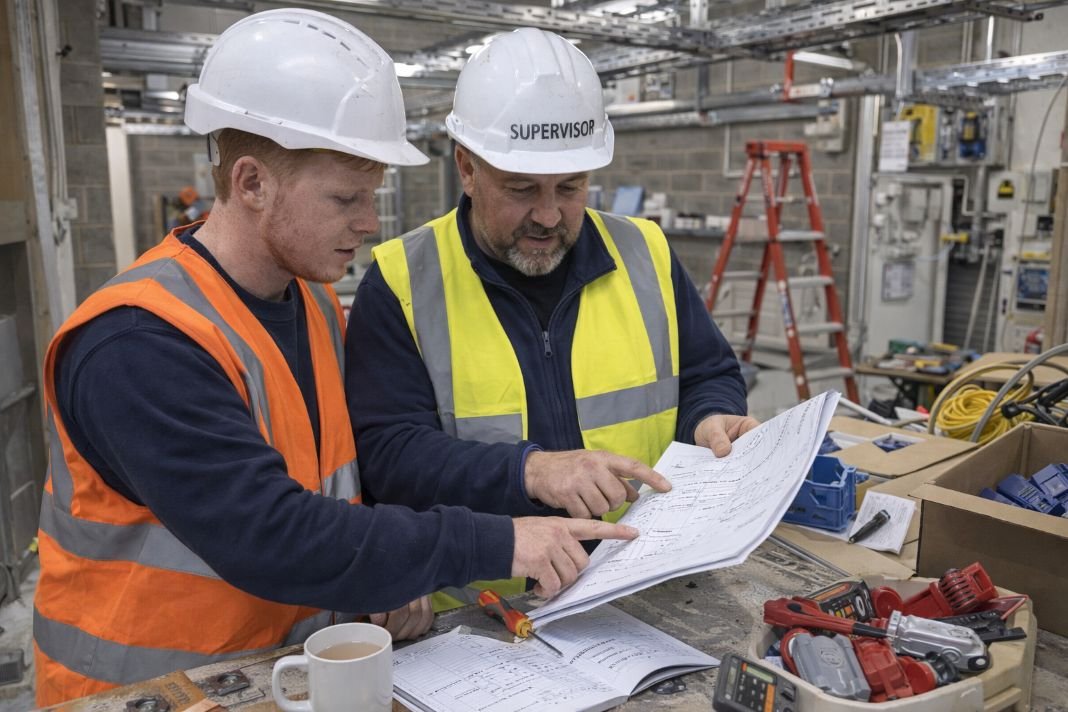
AI image of construction team discussion on-site
Pro Tip 2: Label your portfolio evidence with dates and clear descriptions immediately after completing tasks to avoid confusion later.
Construction NVQ timelines: level-by-level breakdown
Construction NVQs are often more flexible than people expect because they are assessed in the workplace, not through a fixed teaching calendar. That flexibility makes the timeline easier to fit around work, but it also means completion depends heavily on what you can evidence.
Level 2 NVQs
Level 2 is usually aimed at skilled operatives in a specific trade, such as plastering, roofing, steel fixing, decorative finishing, fitted interiors, or building maintenance. Experienced workers often complete a Level 2 NVQ in roughly 4 to 8 weeks if they already have strong site evidence.
Evidence usually includes workplace observation, photos, documents, and a portfolio showing competence in core trade tasks. A worker seeking the blue skilled worker CSCS card often uses this route once the qualification is complete.
Level 3 NVQs
Level 3 often suits advanced tradespeople, occupational work supervisors, or those covering health and safety responsibilities. Timelines commonly fall between 6 and 12 weeks for someone already operating at that standard.
Supervisory evidence can take longer to assemble than trade evidence because it may involve planning work, monitoring standards, or managing others. Gold card progression often sits in this part of the route, depending on the exact qualification and card requirements.
Level 4 NVQs
Level 4 is linked to site supervision and similar roles, including supervising lifting operations. A realistic completion time is often 2 to 4 months.
At this stage, assessors usually need evidence of coordination, communication, compliance, and team oversight rather than hands-on trade output alone. Much of the work is document based, including records you already produce in the role.
Level 6 NVQs
Level 6 is where many site managers and senior operational staff focus their attention. A Level 6 construction NVQ completion time often sits between 3 and 6 months, although some learners finish sooner if they already manage programmes, resources, safety, and subcontractors in a well-documented way.
The qualification can support progression to the black CSCS manager card, subject to the usual card application requirements. Portfolio evidence at this level often includes RAMS, site reports, meetings, inspections, programme input, and management records.
Level 7 NVQs
Level 7 is aimed at senior management. Completion can take around 4 to 8 months because evidence needs to show strategic responsibility, commercial awareness, leadership, and high-level decision-making.
A senior manager with direct control over teams, budgets, procurement, and business planning can usually move through the process far more smoothly than someone with an impressive title but limited documentary responsibility. At this level, the portfolio has to reflect the reality of the job.

AI image of construction workers reviewing plans at site
Electrical NVQ and City & Guilds course durations
Electrical qualifications do not all follow the same pattern. Some are workplace NVQs, some are exam-led courses, and some combine practical assessment with portfolio work. That is why electrical NVQ duration and City & Guilds course length vary more than many people expect.
- City & Guilds 2346-03 Experienced Worker Qualification often takes several months because it includes knowledge, performance evidence, and practical assessment for experienced electricians seeking formal recognition.
- City & Guilds 2366-03 Technical Occupational Entry in Electrical Installations is a longer route for new entrants and career starters. It generally takes much longer than an experienced worker route because it builds occupational competence from an earlier stage.
- City & Guilds 2357 Level 3 NVQ Diplomas in Electrotechnical Technology depend on workplace access, portfolio progress, and assessment availability. Learners already employed in relevant electrical work move faster.
- City & Guilds 2382-22, commonly known as the 18th Edition, is much shorter. The course and exam can usually be completed over a short period compared with an NVQ.
- City & Guilds 2391-52 Inspection and Testing also has a shorter timetable than a full NVQ, although preparation time varies depending on prior experience with inspection, testing, and certification.
- EAL qualifications such as PAT Testing and Building Regulations for Electrical Installations in Dwellings are typically shorter still, often focused on a specific knowledge area or skill set.
For electrical learners, exam scheduling matters. Practical assessments and exams are attended in person, and for learners using the Loughton, Essex training centre, that centre-based element becomes part of the overall timeframe. By contrast, the workplace side of an electrical portfolio depends on how quickly suitable jobs can be completed and evidenced.
JIB progression often depends on having the right combination of qualifications, competence, and evidence. Someone who already has years of experience but lacks formal recognition may move through the Experienced Worker route far quicker than a person starting at the beginning of the trade pathway.
What can delay or speed up your NVQ? Common pitfalls and success factors
Most NVQ delays come from a small number of practical problems, and nearly all of them can be reduced with better preparation.
Poor evidence is one of the biggest issues. If photos have no explanation, documents are missing dates, or files do not clearly show your role, the assessor cannot simply assume competence. A tidy, labelled portfolio saves time at every stage.
Another frequent problem is limited access to the right work. A learner registered on a supervision or management qualification still needs evidence of supervision or management. If the job role changes halfway through, the assessment may slow until fresh evidence is available.
Organisation matters just as much as experience. Learners who respond quickly to feedback, keep documents together, and book assessment visits promptly usually progress better than those who leave everything until the end.
A useful approach is to keep this short evidence routine in mind:
- Save documents as you go, not weeks later.
- Label each file clearly with date, site, and task.
- Ask early if you are unsure whether a piece of evidence is suitable.
Strong employer support can also shorten the path. A manager who confirms duties, allows observations, and signs witness testimony promptly removes a lot of friction from the process. Where support is weak, learners often spend extra time chasing signatures and explaining tasks after the event.
At MOS Training Centre, as with any provider running workplace assessment, the fastest learners are usually the ones who treat the NVQ like an active project rather than paperwork to revisit when the site quietens down.
Understanding NVQ costs and value for time invested
Price matters, but time matters as well. A cheaper qualification route is not always better value if it drags on unnecessarily or does not match your actual role.
Construction NVQ prices often follow the level of responsibility involved. Current fees commonly sit at £650 for Level 2, £980 for Level 3, £1,190 for Level 4, £1,500 for Level 6, and £2,100 for Level 7. Electrical course prices vary by route, with examples including £1,600 for the 2346-03 Experienced Worker Qualification, £1,600 for the 2357 NVQ, £2,560 for the 2366-03, £392 for the 18th Edition, and £1,200 for 2391-52.
Those fees generally cover assessment and qualification costs, though the exact structure depends on the course. For learners, the bigger question is usually what the qualification leads to within a realistic timeframe.
A Level 2 or Level 3 construction NVQ may support access to the CSCS card needed for site roles. A Level 6 can support progression into site management. In electrical work, the right mix of City & Guilds, EAL, and NVQ achievements can support JIB grading, wider job access, and movement into specialist areas.
Employer funding or group arrangements can change the picture again. Where a business needs several workers qualified at once, the time value can be seen in site access, compliance, and promotion planning across the team, not just in one person’s fee.
Book Your NVQ Assessment
Find out your ideal NVQ pathway with expert advice and flexible assessment options tailored to your experience.
The UK industry context: why NVQ timelines matter more than ever
NVQ timelines matter because qualification timing affects site access, promotion, and employability in a market that still needs skilled people. The UK construction industry remains under pressure to bring in and retain qualified workers, and electrical demand is also rising, especially in areas linked to renewable energy and EV charging.
CSCS requirements are becoming tighter on many projects. For experienced workers who have done the job for years without formal qualifications, the question is often no longer whether to get an NVQ, but how quickly they can complete one that reflects their real role.
CITB continues to point to skills demand across construction, and the wider labour picture supports the same idea. A delayed qualification can hold back card applications, job moves, and progression into supervision or management at exactly the point when employers need competent people in post.
Electrical work shows a similar pattern. Updated regulations, specialist testing needs, and newer technologies all place more weight on recognised qualifications. That does not mean every learner needs the same route. It does mean that waiting too long to sort out the right pathway can narrow options later.
Seen in that light, NVQ duration is not just an admin detail. It becomes part of career planning.
Final thoughts: what most people get wrong about NVQ timelines
The biggest mistake is assuming that every NVQ takes a fixed number of weeks. It does not. The calendar matters less than the match between your role, your evidence, and the qualification level.
Some people also assume fast-track means easy. In reality, fast-track means you are already competent and can prove it properly. Others go the other way and think an NVQ must take ages, even when they already have years of relevant site evidence sitting in diaries, reports, and phone photos.
A realistic NVQ timeline usually comes down to three things:
- choosing the right level for the job you actually do
- gathering evidence consistently instead of in one last rush
- treating assessor feedback as part of progress, not a setback
Anyone planning an NVQ sensibly should think less about the shortest possible finish date and more about steady, well-supported completion. That approach usually gets you qualified sooner than guesswork ever will.