
What happens at an NVQ assessment visit, and how should you get ready?
An NVQ assessment visit is usually a planned review of the work you already do on site or in your workplace. An assessor watches you carry out normal tasks, looks at evidence for your NVQ portfolio, and talks through how your job matches the assessment criteria. Preparation usually means having the right documents, evidence, and site access ready, rather than revising for a formal test.
Here's What We Have Covered In This Article
NVQ Assessment Visits Explained: What to Expect on the Day
An NVQ, or National Vocational Qualification, is based on workplace competence. That means the assessment visit is focused on your real job, not on a one-off exam performance. Most people find that the day feels much more like a structured site meeting than a test.
Once the visit is booked, your assessor will usually confirm where they are meeting you, what work you are doing that day, and what evidence may be useful to have ready. In construction, this often happens on a live site. In electrical qualifications, the visit may take place in a working environment linked to the qualification route, depending on whether the award is through City & Guilds or EAL and how the unit is assessed.
A typical NVQ site visit often follows a simple pattern:
- The assessor arrives, checks in, and explains the plan for the visit.
- The assessor observes you carrying out normal work tasks relevant to your NVQ.
- The assessor asks questions as part of a professional discussion to confirm knowledge behind your actions.
- The assessor reviews evidence for your portfolio, including documents, photographs, or witness statements.
- The assessor explains what has been covered and whether anything else is still needed.
During the observation, the assessor is not trying to catch you out. Their role is to judge whether your everyday work meets the standards set by the awarding body, such as ProQual, City & Guilds, or EAL. If something cannot be seen on the day, it may be covered through existing evidence or a later visit.
No written test is usually part of the site visit itself. Trick questions are not the point either. If an assessor asks why you chose a method, used certain PPE, or followed a sequence of work, they are checking that your practical skills and working knowledge match the NVQ requirements.
Pro Tip 1: Confirm your site access arrangements a day before the assessment to avoid delays or interruptions.
Who Needs an NVQ Assessment Visit? Understanding the Audience
Assessment visits are most relevant for people whose qualification has to be proved through workplace evidence. That includes many construction trades, supervisors, managers, and electrical workers following competence-based routes.
If you are trying to work out whether this applies to you, the clearest guide is your current role and the qualification pathway you are taking.
- Experienced site workers usually need an assessment visit if they are completing an on-site NVQ based on the work they already do. This is common for plasterers, roofers, steel fixers, painters, cladding installers, site supervisors, and managers.
- Electricians may need workplace assessment where the qualification requires evidence of real installation work, inspection, testing, or ongoing competence linked to JIB grading or industry recognition.
- Employers often arrange visits for several members of staff when a team needs formal qualifications for contract requirements, progression, or CSCS card applications.
- New starters may not move straight into an on-site NVQ if they do not yet have enough relevant work activity to be assessed against.
- Career changers sometimes begin with training first, then move into workplace assessment once they are in a suitable job role.
A fast-track NVQ is usually aimed at experienced workers who already perform the job to the right standard but do not yet hold the formal qualification. In that case, the visit is part of proving existing competence, not teaching the trade from scratch.
For many people, the assessment visit matters because it sits between experience and formal recognition. A worker may already be doing the job every day, but an NVQ gives that experience a recognised structure that can support card applications, progression, or employer requirements. MOS Training Centre delivers construction NVQs through on-site assessment across the UK, which means learners do not usually need to travel for that part of the process.
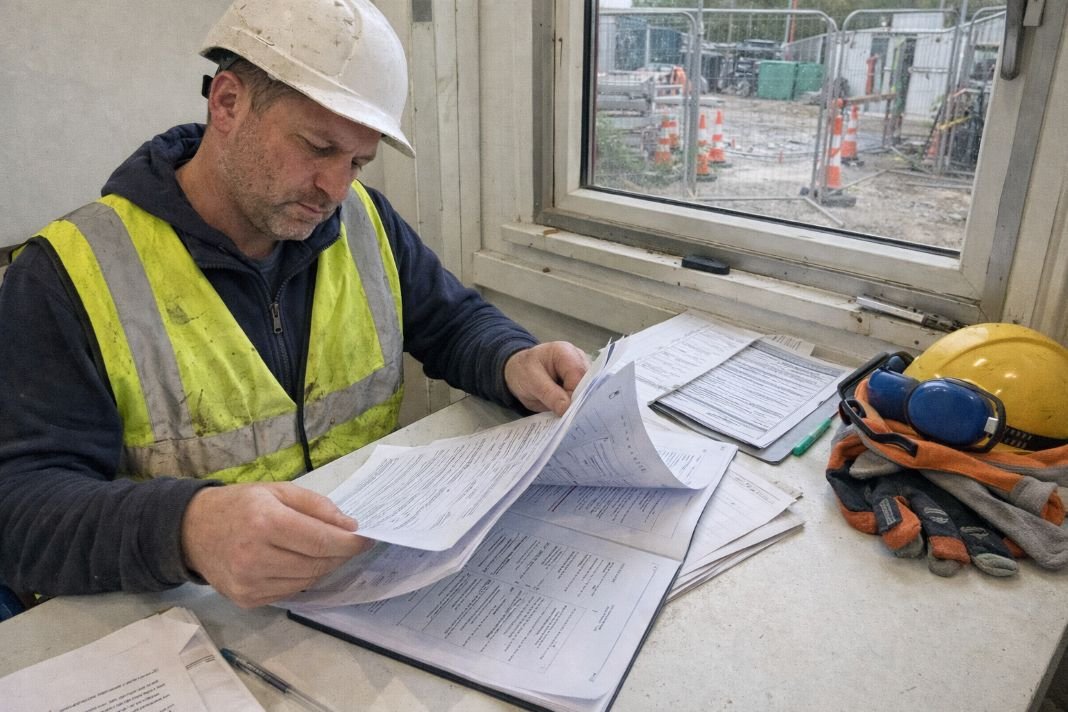
AI image of construction worker on-site
Pro Tip 2: Keep digital photos and site documents organised by project and date so your NVQ portfolio is easy for assessors to verify.
What Assessors Look For: Evidence, Observation, and Discussion
Assessors look for proof that you can do your job safely, consistently, and to the required standard. They are judging competence over time, using a mix of direct observation and supporting evidence.
Observation on site
Observation is often the strongest part of the NVQ assessment process. The assessor watches you carry out real tasks and notes how you work, how you follow site rules, how you use tools and materials, and how you deal with the job in front of you.
On a construction NVQ, that may include setting out, installing materials, using access equipment correctly, following method statements, or keeping the work area safe and organised. On an electrical route, observation may cover practical installation work, safe isolation, testing procedures, or compliance with the relevant standard for the qualification being assessed.
Evidence for the NVQ portfolio
Your NVQ portfolio is the record that supports what the assessor sees. The exact evidence can vary by trade and level, but common examples include:
- Photographs of work in progress and completed work
- Job sheets, work orders, or site diaries
- Drawings, plans, or marked-up documents
- Risk assessments, method statements, or permits where relevant
- Witness statements from supervisors or managers
- Inspection records, test results, or sign-off sheets
- Training records, cards, or certificates linked to your role
Strong evidence is usually clear, dated, and linked to your own work. A pile of unrelated paperwork is much less useful than a smaller set of documents that directly shows what you have done.
Professional discussion
A professional discussion gives you the chance to explain decisions that may not be obvious from observation alone. You may be asked about materials, sequencing, safety controls, regulations, or how you deal with changes on site.
Many learners worry about saying the wrong thing here. In practice, the discussion is usually straightforward because it is based on the work you already know. If you can explain your normal process in plain terms, that often gives the assessor what they need.
Does an NVQ have a pass or fail day?
An NVQ assessment visit is rarely about one perfect performance. If some criteria are covered and others still need more proof, the assessor will normally tell you what is missing. That might mean extra evidence, another observation, or a witness testimony to complete the portfolio.
That approach is one reason the process feels different from a classroom exam. Competence is built from the work itself, including routine tasks done properly on a normal day.
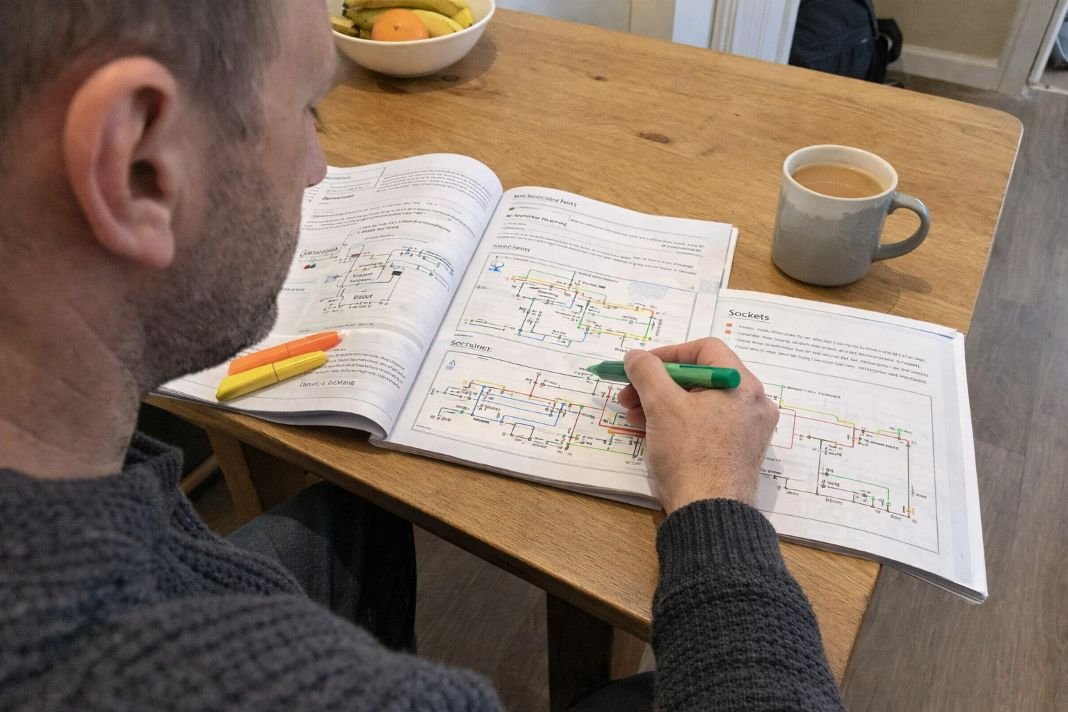
AI image of construction worker reviewing plans at site
How to Prepare for Your NVQ Assessment Visit: Practical Checklist
Good preparation usually saves time on the day and reduces the chance of follow-up requests for basic information.
- Gather your evidence in advance. Put photographs, job records, drawings, and any relevant site paperwork in one place so the assessor can review them without delay.
- Check that your evidence is clearly yours. Add dates, locations, job details, or short notes where needed so each item makes sense in context.
- Confirm what work you will be doing on the visit day. The assessor needs to see tasks that match the units in your NVQ, so a quiet or unsuitable day may not be useful.
- Tell the right people on site. Your supervisor, manager, or office contact should know that an assessor is attending and that site access may be needed.
- Make sure your PPE is complete and in good condition. If normal site rules require boots, hard hat, eye protection, gloves, or high-visibility clothing, have them ready as usual.
- Keep your phone or camera records organised if you use them for evidence. A folder by site, date, or job can make a big difference.
- Bring any identification or qualification records requested by the assessor. Some visits also rely on cards, permits, or previous certificates to support the portfolio.
- Ask in advance if you are unsure what counts as evidence. It is much easier to clarify before the visit than to rebuild missing records afterwards.
Site preparation matters as well. If access is delayed at the gate, if the manager has not been informed, or if your work area is not available, the day can become less productive than it should be.
Colleagues do not need to treat the visit as a special event, but they should know why the assessor is there. A quick word with the relevant people often avoids awkward interruptions during observation.
Costs, Timelines, and What Happens After the Visit
Costs depend mainly on the NVQ level rather than on the visit itself, because the assessment is part of the full qualification. Current construction NVQ prices at MOS Training Centre are £650 for Level 2, £980 for Level 3, £1,190 for Level 4, £1,500 for Level 6, and £2,100 for Level 7.
Timing can vary because some learners already have strong evidence and active site work, while others need a longer period to cover all units. One visit may be enough for some parts of the qualification, but many portfolios need further evidence or another observation before completion.
After the visit, the assessor usually reviews what has been collected and records progress against the NVQ criteria. You may then receive feedback on three broad points:
- What has been achieved already
- What further evidence is still needed
- Whether another assessment visit or discussion is required
Extra evidence does not mean something has gone wrong. A manager-level NVQ, for example, may need planning records, site meetings, or health and safety documents that were not available on the first day. A trade NVQ may need photographs from another stage of work if the task observed was only part-complete.
Once the portfolio is complete and internally checked, the awarding body, such as ProQual, City & Guilds, or EAL, can process the qualification. If your aim is a CSCS Card, the NVQ may support your application for the relevant card, although CSCS requirements can vary by role, employer, and contract. Electrical workers following competence-based routes may also use completed qualifications as part of progression linked to JIB grading, depending on the exact pathway.
Delays often come from ordinary practical issues: missing dates on evidence, unclear photographs, no witness statements where one is needed, or gaps between assessment visits because the right work is not taking place. A well-organised portfolio usually moves faster than a rushed one built after the event.
Speak to an NVQ Adviser
Connect with an experienced advisor for guidance on the NVQ routes and site assessment requirements.
Common Misconceptions and Mistakes to Avoid
A lot of anxiety around NVQ visits comes from misunderstandings about what the assessor is actually looking for. Clearing those up early can make the whole process feel more manageable.
Myth: You need to be perfect on the day. Reality: Assessors are looking for competent, safe, work-based performance. Small interruptions, site changes, or normal working adjustments are part of real life.
Myth: The more paperwork you bring, the better. Reality: Relevant evidence matters more than volume. Ten useful documents linked to your work are stronger than a large bundle with no clear connection to the units.
Myth: The assessor is there to find faults. Reality: The assessor is there to measure your work against the NVQ standard. If something is missing, they usually explain what further evidence can fill the gap.
Myth: You can leave all evidence gathering until the end. Reality: Last-minute evidence is often incomplete, poorly labelled, or impossible to trace back to the job. Photographs taken during the work are usually much stronger than trying to recreate proof later.
Myth: Site management does not need to know about the visit. Reality: Access, timing, and cooperation matter. If the right people have not been informed, the assessor may not be able to see the work properly.
One common mistake is assuming that the professional discussion is separate from daily work. In fact, it is often the easiest part for experienced workers because it draws on methods they use every week. Another is forgetting that routine records, including job sheets or site briefings, can carry useful evidence if they are kept clearly and linked to your role.
The Bigger Picture: How NVQ Assessment Supports Your Career
An NVQ assessment visit can feel like an administrative hurdle when you first look at it. In practice, it often acts as the link between years of site experience and a qualification that employers, contractors, and card schemes recognise.
For experienced workers, that matters because practical ability alone is not always enough to prove competence on paper. Many people in UK construction and electrical work have strong skills but no formal qualification to match. On-site assessment gives those workers a route to show what they already do in a structured way.
Career progression is often tied to that formal recognition. A trade NVQ may support access to the right CSCS Card. A supervision or management NVQ can support movement into roles with more responsibility. Electrical qualifications assessed through recognised awarding bodies can also support progression where industry grading or compliance expectations apply.
The wider industry context matters too. UK construction continues to need qualified workers across trades, supervision, and management, and demand for electricians is shaped by ongoing installation, maintenance, inspection, and newer areas such as low-carbon technologies. In that setting, qualifications have practical value because they help employers judge competence and help workers show where they stand.
A good assessment visit does not turn someone into a skilled worker overnight. What it does is record real competence properly, which can open the door to the next stage of a working life that is already under way.