Which electrical course should you take first, and what is the usual order?
Most people who are new to the trade start with a Level 3 entry qualification in electrical installations, then add the 18th Edition, move into workplace experience, and complete an NVQ if their route requires occupational competence on site. Experienced workers often follow a shorter path, because their existing work can count toward the right qualification.
A typical electrical course order looks like this:
- City & Guilds Level 3 Technical Occupational Entry in Electrical Installations (2366-03) for new entrants
- City & Guilds 18th Edition, which is BS 7671:2018, to build current wiring regulations knowledge
- Workplace experience in a suitable electrical role
- City & Guilds Level 3 NVQ Diploma in Electrotechnical Technology (2357), where relevant
- City & Guilds Inspection and Testing (2391-52) once core installation knowledge and site experience are in place
Another route applies to those who are already working as electricians but lack formal recognition. In that case, the City & Guilds Experienced Worker Qualification (2346-03) may be the right first step. MOS Training Centre delivers these electrical qualifications from its training centre in Loughton, Essex, with in-person assessment and exams where required.
Here's What We Have Covered In This Article
Who should take which electrical course first? Matching pathways to background
The right starting point depends less on age and more on experience, current job role, and what you need the qualification to lead to. A career changer has different needs from someone who has spent years on site, and an employer planning staff training will usually look at competence across a team rather than one person at a time.
Career starters and career changers
Anyone entering the trade without solid electrical experience will usually need a foundation course first. For many learners, that means the City & Guilds 2366-03, which covers the technical knowledge and practical basics needed before moving into work-based assessment.
That route suits people who want a beginner electrician course with clear structure. It is also suitable for those who need time to build confidence before entering a workplace where evidence for an NVQ can be gathered.
Experienced electrical workers
Workers who already install, test, or maintain electrical systems may not need to begin at entry level. If your day-to-day work already shows occupational competence, the Experienced Worker Qualification, known as 2346-03, can be a better fit.
That route exists because many capable workers have years of practical ability but no formal qualification. In those cases, the issue is often qualification mapping rather than learning from scratch.
Employers upskilling staff
Employers usually need to match training to the actual work being carried out. A junior improver may need a full training pathway, whereas a long-serving electrician may need the qualification that confirms existing competence for JIB grading or contract requirements.
Group planning also matters. One employee may need the 18th Edition, another may need 2391, and another may be ready for an NVQ-based route linked to site evidence and current responsibilities.
A common self-assessment mistake
Plenty of people assume that confidence with tools means readiness for any electrical qualification. Course choice is better based on evidence, job scope, and whether you already work in an environment where assessors can verify your competence through real tasks.
Pro Tip 1: Check the requirements for your current or desired job role to select a course that aligns with actual site or employer expectations.
Comparing key electrical qualifications: What each course involves
Names and course numbers can make the electrical training pathway seem more complicated than it is. The simplest way to compare them is to look at who each course is for, what it covers, and how it is assessed.
Main electrical qualifications at a glance
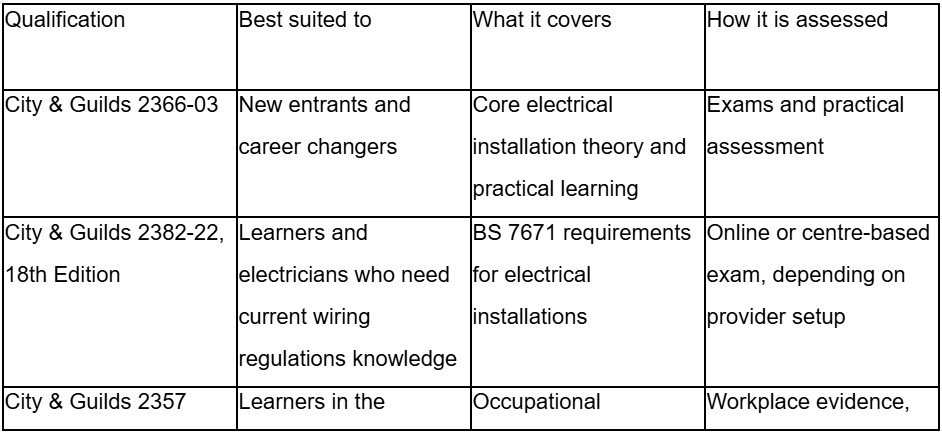
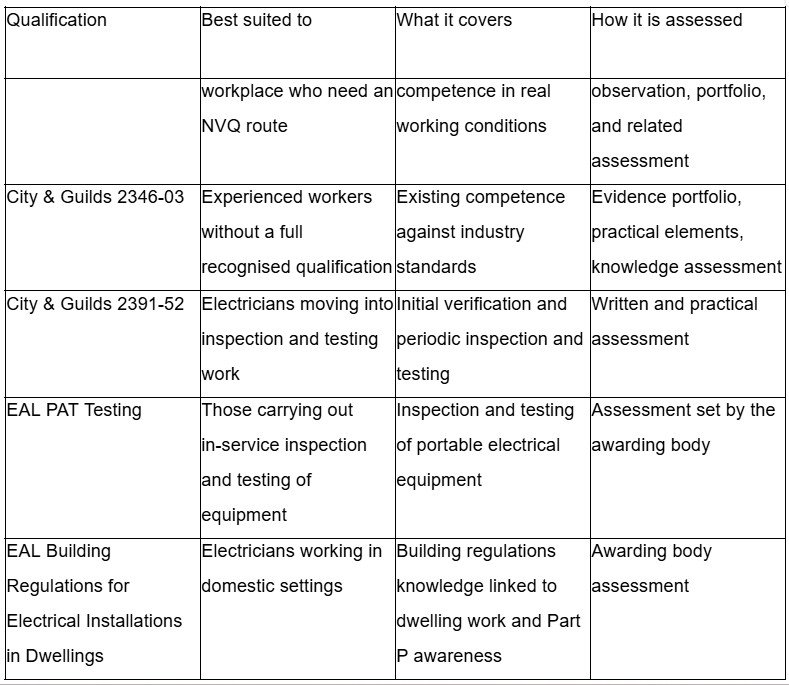
A few distinctions matter more than the course code. The 2366 is a technical learning route for beginners, the 2357 is an NVQ linked to actual site competence, and the 2346 is aimed at experienced workers who need their skills recognised through a formal qualification.
The 18th Edition sits slightly differently from those routes because it is a regulations qualification rather than a full occupational pathway on its own. By comparison, 2391 is usually taken after somebody has solid installation knowledge and enough practical experience to understand inspection and testing in real settings.
Pro Tip 2: Keep an organised portfolio of your work and evidence if your route involves workplace assessment, as it can speed up qualification mapping.
The order of electrical courses: Typical progression routes
Electrical qualification order usually follows the logic of safe practice. You learn the principles, understand current regulations, build competence at work, then add specialist qualifications as your role becomes more advanced.
For a new entrant, the pathway usually looks like this:
- Start with City & Guilds 2366-03 to build technical knowledge and practical grounding.
- Take the 18th Edition so you understand the current wiring regulations used across UK electrical work.
- Move into relevant site or installation work where your skills can be developed in live conditions.
- Complete the 2357 NVQ if your role and training route require occupational evidence in the workplace.
- Add 2391 if inspection and testing forms part of your job or plans.
For an experienced worker, the sequence often shortens. Someone already carrying out electrical work at the right level may move straight into 18th Edition if it is missing, then take the 2346-03 Experienced Worker Qualification, and later add 2391 if inspection duties are needed.
Timing matters with the 18th Edition. Some learners take it early because employers expect current regulations knowledge, but it makes more sense once you have enough technical context to apply the rules properly. Reading BS 7671 without any installation background can feel abstract very quickly.
JIB progression also shapes the order for many electricians. If your long-term aim involves recognised grading, approved status, or stronger access to certain roles, the qualification ladder needs to support that destination rather than simply adding random certificates.

AI image of electrician on-site
What each qualification leads to: Jobs, cards, and career progression
Electrical qualifications matter because they connect to actual work, site access, and career movement. A course only makes sense if it supports the kind of electrician you plan to become.
A learner who completes 2366 has shown technical study and practical training, but that alone does not mean full occupational competence. It can open the door to trainee roles, mate positions, or structured employment where further workplace development takes place.
An NVQ such as 2357 has a different purpose. It confirms that an electrician can perform to the required standard in real working conditions, which means that it is often far more important for recognised occupational status than a classroom-only qualification.
The 18th Edition supports employability because many employers expect current knowledge of wiring regulations. Even so, it does not replace installation competence, and it does not turn a beginner into a qualified electrician by itself.
Inspection and Testing, known widely as 2391, can support progression into roles with greater responsibility for verification, fault finding, certification, and reporting. That extra layer can be useful for contractors, maintenance electricians, and those whose work includes compliance-focused tasks.
CSCS cards and JIB registration add another practical consideration. A CSCS card, or Construction Skills Certification Scheme card, is often linked to site access. JIB, the Joint Industry Board, relates to grading and registration standards in the electrical industry. The exact card or registration outcome depends on the qualification combination, current role, and employer or contract requirements, so readers should always check the latest criteria before making assumptions.
Common mistakes and misconceptions about electrical course order
Electrical training errors usually happen because course titles sound similar, or because one qualification gets mistaken for a full career route. A few myths appear again and again.
- Myth: The 18th Edition is always the first course to take. Fact: The 18th Edition is important, but many beginners need broader installation training first. Regulations knowledge makes more sense once you understand the basics of electrical systems and safe working practice.
- Myth: One course makes you fully qualified on its own. Fact: Most people need a sequence of learning, workplace experience, and competence-based assessment. A single certificate rarely covers everything needed for the job market.
- Myth: Experienced workers must start from the beginning. Fact: The 2346-03 Experienced Worker Qualification exists for people who already have substantial practical experience. That route can save time if your evidence and job role are suitable.
- Myth: An NVQ is only for complete beginners. Fact: An NVQ, or National Vocational Qualification, is about proving competence at work. It is often most relevant once a person is already carrying out real electrical tasks in the workplace.
- Myth: 2391 should come immediately after the first entry course. Fact: Inspection and testing usually works better after core installation knowledge and real site experience have been built up. Without that base, the assessment can feel disconnected from day-to-day practice.
A lot of wasted time comes from collecting qualifications in the wrong order. Someone who takes specialist courses too early may still lack the evidence or occupational standing needed for the next career step.
Book Your Electrical Course Consultation
Discuss your background with our experts to pick the right electrical training pathway for your goals.
UK industry context: Why course order matters now more than ever
The order of electrical courses matters more today because the market is asking for proven competence, current regulations knowledge, and qualifications that match actual job duties. UK construction and building services employers are under pressure to recruit skilled people who can work safely and meet contract standards.
CITB has highlighted continuing skills shortages across construction, and industry forecasts often point to strong future demand for electricians. Separate projections have also suggested that the UK will need a large number of additional electrical workers over the coming years, especially as infrastructure, housing, renewable energy, and EV charging work expand.
That demand does not mean every qualification carries equal weight. Employers usually want the right qualification in the right place, such as:
- entry training for new starters
- regulations knowledge for current compliance
- workplace competence through an NVQ or experienced worker route
- specialist testing qualifications where the role requires them
Site access expectations are also becoming tighter on many projects. CSCS-related requirements and client standards often push workers to formalise skills that may once have been accepted informally.
New technologies add another layer. Electricians who plan to work around low-carbon systems, updated building standards, or more advanced testing duties may need ongoing upskilling long after their first qualification. The old idea of taking one course and being finished for life fits fewer careers than it once did.
What to prepare before enrolling: Practical checklist
Preparation can make the enrolment stage much smoother, especially if you are choosing between City & Guilds, EAL, and NVQ-based options. The right documents and a realistic study plan will save time later.
- Confirm your current experience level honestly, including any site work, domestic jobs, maintenance duties, or supervised installation work.
- Gather proof of identity and any previous certificates you already hold.
- Check whether your chosen route needs access to a real workplace for observations or evidence collection.
- Review course costs carefully. Current pricing can vary widely, from £392 for the 18th Edition to £2,560 for the 2366-03, with other qualifications sitting between those figures.
- Set aside time for study, revision, assessment dates, and travel if your exams or practical assessments take place at a centre.
- Make sure your current role matches the qualification aim if you plan to take an NVQ or experienced worker route.
- Keep records of your work where relevant, including photos, job sheets, or employer confirmation, if the qualification uses workplace evidence.
For learners taking electrical courses in Essex or London, MOS Training Centre uses its Loughton training centre for electrical delivery and assessment. Construction NVQs work differently because those are assessed on site, but electrical learners should expect centre attendance where the qualification requires exams or practical tasks.
Looking ahead: Rethinking the right order for electrical courses
The usual qualification ladder is useful, but it is still a guide rather than a rigid rule. A school leaver, a domestic installer, a maintenance electrician, and an experienced worker returning to formal study may all need a different starting point even if their long-term aim sounds similar.
Future career planning in electrical work is likely to become more flexible, not less. Regulations change, technologies shift, and employers often expect people to add qualifications as their role grows.
That is why the best course order is the one that matches where you are now, what work you already do, and what you need next. A sensible sequence builds from competence and purpose, leaving room for further learning as the industry changes.