
What does the 2391 Inspection and Testing exam involve, and how should you prepare?
The City & Guilds 2391-52 is an inspection and testing qualification for electricians who need to assess installations properly, record results accurately, and work in line with BS 7671:2018, commonly called the 18th Edition. It usually includes both written and practical assessment, so preparation needs to cover technical knowledge, testing sequence, fault finding, and paperwork. Strong candidates revise the regulations, practise using test instruments confidently, and spend time on certificates as well as the testing itself.
Here's What We Have Covered In This Article
Understanding the 2391 Inspection and Testing Exam
The 2391 is shorthand for City & Guilds 2391-52 Initial and Periodic Inspection and Testing of Electrical Installations. In simple terms, it checks whether an electrician can inspect an installation, carry out the right tests, identify issues, and complete the correct certification.
That matters because inspection and testing sits close to safety, compliance, and professional judgement. Anyone carrying out electrical inspection work needs more than a basic grasp of wiring methods. They need to know what to test, when to test it, what the results mean, and how to document those results properly.
Initial verification and periodic inspection are linked, although they are not the same task. Initial inspection and testing applies to new work or altered work before it is put into service. Periodic inspection and testing applies to existing installations that need to be assessed for ongoing safety and condition. One focuses on verifying new electrical work from the start, whereas the other checks whether an installation has remained safe over time.
Employers often value the inspection and testing qualification because it shows a recognised level of competence in an area where mistakes can have serious consequences. The JIB, or Joint Industry Board, also places value on formal qualifications where grading and professional progression are concerned.
Some candidates assume the 2391 exam is almost impossible, and others assume it is simply an extension of the 18th Edition. Neither view is especially useful. The 18th Edition tests knowledge of the wiring regulations, whereas 2391 asks you to apply that knowledge in practical inspection, testing, and certification work. MOS Training Centre delivers this City & Guilds course for electricians who need that next step in competence, not just another textbook pass.
Pro Tip 1: Rehearse the full testing sequence on a training rig multiple times until the steps feel methodical and automatic.

Pro Tip 2: Practise filling out inspection certificates using real test results to identify and eliminate mistakes before the assessment.
Who Should Take the 2391 Exam?
The 2391 suits electricians who already have a grounding in electrical installation and need to move into inspection and testing work with more confidence and formal recognition.
- Experienced electricians who inspect, test, or certify their own work
- Qualified electrical workers aiming to strengthen JIB grading or job prospects
- Employers who need staff with recognised inspection and testing competence
- Electricians moving into roles linked to maintenance, compliance, or condition reporting
An experienced installer is often the most obvious candidate. Someone who already works on domestic, commercial, or industrial systems may reach a point where testing and certification become part of the role every week. At that stage, the inspection and testing qualification becomes highly relevant.
Career changers and newer entrants need a more careful decision. A candidate still building core installation knowledge may need to complete the right installation qualification first, then move on to 2391 once testing theory and on-site practice make more sense together. The qualification is valuable, but timing matters.
Employers also look at 2391 from a workforce planning angle. A team that can install but cannot inspect or certify efficiently may face delays on handover, sign-off, and maintenance work. In those settings, sending suitable electricians for City & Guilds 2391-52 can support both compliance and job eligibility.
CSCS card requirements and site access rules vary depending on the role and the contract, so 2391 is not a universal requirement for everyone in electrical work. Still, for electricians whose job includes verification, periodic inspection, or reporting on existing installations, it often becomes an important part of the broader qualification route.
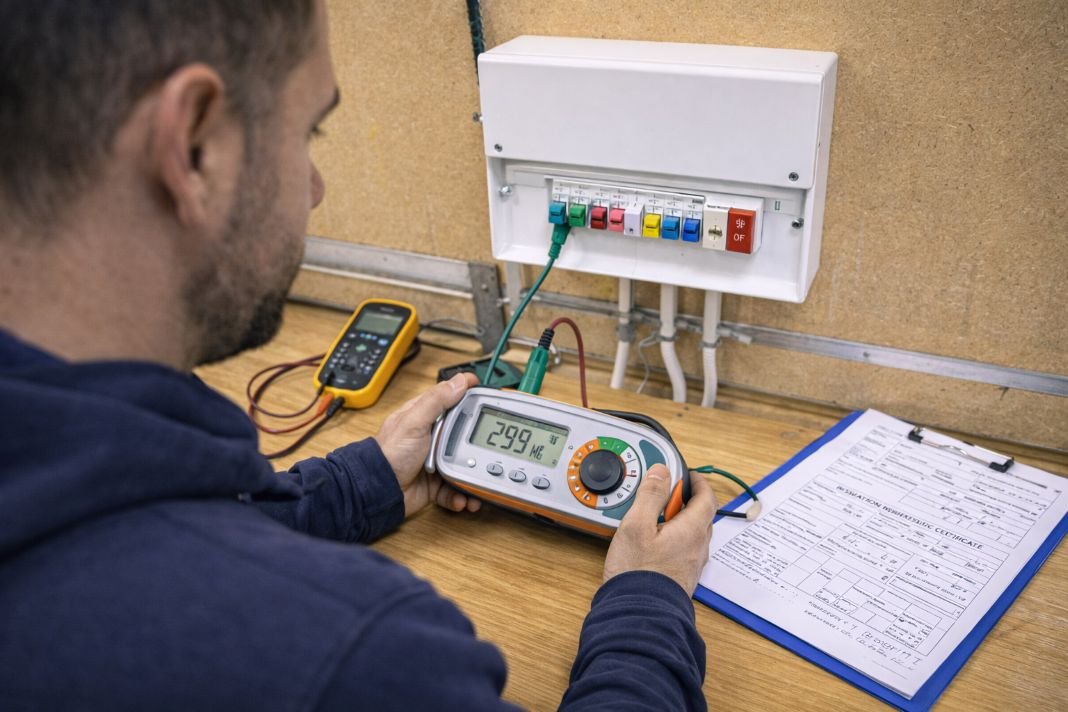
AI image of electrician learning
What the 2391 Exam Involves: Format, Content, and Assessment
Most people want to know what actually happens in the assessment. The simplest answer is that the 2391 exam tests both what you know and what you can do under assessment conditions.
- Written assessment This checks your grasp of inspection, testing procedures, regulations, safe isolation, interpretation of results, and certification requirements.
- Practical assessment This requires you to inspect and test an installation or test rig, carry out the correct sequence, identify defects or issues, and use instruments properly.
- Documentation and certification This part focuses on recording results accurately and completing the right paperwork in a way that reflects the findings.
During the practical element, assessors are not simply watching for speed. They are looking for safe working practice, correct test selection, sensible sequencing, accurate readings, and a clear understanding of what each result means. Good technique matters, although good judgement matters just as much.
A common pressure point is the paperwork. Some candidates perform the tests reasonably well, then lose marks through incomplete or inaccurate certification. Others know the forms in theory but struggle to link the recorded values to the actual inspection and testing process. That gap shows up quickly in assessment.
At a centre such as MOS Training Centre in Loughton, Essex, candidates typically attend in person for the assessed parts of the course. The location is convenient for many learners travelling from London and Essex, with Debden Station nearby, and the centre setting helps keep the process structured and focused. By the time the assessment starts, you need to be comfortable with your instruments, your test sequence, and your decisions on the page.
How to Prepare for the 2391: Study Tips and Common Mistakes
Preparation works best when theory and practice are revised together. Reading BS 7671:2018 matters, but practical confidence with dead tests, live tests, inspection routines, and certification is what turns that knowledge into exam performance.
Revise the testing sequence until it feels natural
Many candidates know individual tests but become uncertain about the order. That hesitation can cause errors, missed steps, or confusion during the practical element. Regular repetition of the sequence, with a reason for each step, usually makes a bigger difference than passive reading.
Spend real time on certificates
The forms are part of the job and part of the assessment. Candidates often give most of their attention to instrument readings, then treat documentation as an afterthought. A better approach is to practise completing certificates from sample scenarios until the process feels normal.
Use mock questions and practical repetition
Written revision needs more than reading notes once. Mock exam papers, scenario-based questions, and timed practice can expose weak areas very quickly. On the practical side, repeated use of a test rig or suitable training setup helps reduce exam nerves because the motions become familiar.
Keep the 18th Edition close at hand
Inspection and testing sits alongside the wiring regulations, so weak regulation knowledge often leads to weak reasoning. A candidate who can carry out a test but cannot relate the result to compliance may struggle in the written assessment and in fault interpretation.
Watch for these common mistakes
- Rushing safe isolation
- Mixing up the order of tests
- Misreading or misrecording results
- Forgetting the purpose of a specific test
- Completing documentation without matching it to actual findings
Hands-on practice remains the part many people overlook. You cannot revise practical competence purely from a book, and you cannot rely on practical habit alone if your written understanding is thin. The strongest preparation blends instrument use, regulation knowledge, and careful paperwork into one routine.
Speak to an Industry Expert
Get tailored advice from our qualified trainers about the best 2391 course options and your eligibility based on your experience.
Costs, Logistics, and What to Expect at the Exam Centre
For many candidates, practical details are just as important as revision. The current price for the City & Guilds 2391-52 at MOS Training Centre is £1,200, which should always be checked at the point of booking in case details change later.
The centre is based in Loughton, Essex, within easy reach of East London and the wider area. For electricians travelling in for assessment, that location is useful because it combines a dedicated training setting with straightforward rail access from the Central Line.
On the day itself, candidates generally need to arrive with suitable identification and anything the provider has asked them to bring in advance. Timings, assessment arrangements, and course structure can vary, so the practical point is to read joining information carefully before attendance.
Results are not always issued immediately on the day, since City & Guilds processes and marking arrangements can affect the timeline. Once results are confirmed, successful candidates receive certification through the awarding body. That waiting period is normal, so the day usually ends with completion of the assessment rather than instant final confirmation.
The Role of 2391 in UK Electrical Careers and Industry Demand
Electrical work in the UK is changing in ways that place more weight on verified competence. Inspection and testing has become more visible in maintenance, compliance, handover, fault diagnosis, and quality assurance, especially where clients expect formal records and consistent site standards.
Skills shortages continue to shape the wider market. The UK construction industry employs around 2.1 million people, and industry forecasts have pointed to substantial labour demand in the years ahead. Electrical trades are part of that picture, with strong demand linked to housing, infrastructure, retrofit work, renewable energy, and EV charging.
In career terms, 2391 can support progression for electricians who want duties beyond installation alone. Some roles involve more responsibility for condition reporting, certification, remedial recommendations, or sign-off. In those situations, inspection and testing competence can strengthen an electrician’s standing with employers and may support JIB-related progression where other requirements are also met.
Experienced workers sometimes have years of practical knowledge but little formal proof of it. A recognised inspection and testing qualification can help bridge that gap, particularly where a client, contractor, or employer wants evidence that the person carrying out the work has been assessed against a known standard. A domestic installer doing straightforward additions may not need the same profile as someone producing reports on existing commercial installations, which shows why context matters so much.
What Many Get Wrong About the 2391 and What Actually Matters
Misunderstandings about the 2391 usually fall into a few familiar categories.
- People treat it as a memory test The exam does require revision, although pure memorisation is rarely enough. Assessors want to see that you understand why a test is being carried out, what the result indicates, and how that feeds into the certificate.
- Candidates focus on instruments and ignore documentation Testing and paperwork belong together. A correct reading with the wrong certificate entry is still a problem.
- Some assume only new entrants take 2391 In practice, many candidates are already experienced electricians who want formal recognition for inspection and testing duties they are starting to carry out more often.
- Others think the qualification is impossible The assessment is demanding, but the difficulty is often overstated. Underpreparation causes more trouble than the qualification title itself.
- A few see 2391 as a ticket that solves everything It is an important qualification, though it still sits within a wider picture that includes experience, sound judgement, safe working habits, and the right installation background.
What actually matters is simple enough to state, even if it takes effort to achieve. You need to inspect carefully, test in the correct order, understand what your readings mean, and complete the documentation with care. Electricians who prepare on that basis usually walk into the exam with a clearer head, and they leave with skills that carry weight well beyond the assessment room.