What does a Level 3 NVQ in Interior Systems or Work Supervision lead to?
A Level 3 NVQ in Interior Systems or Occupational Work Supervision can support progression into higher-responsibility site roles, formal recognition of existing skills, and eligibility for the relevant CSCS Gold Card, depending on the qualification. For many experienced workers, it is the step that turns practical ability into recognised status on site.
Here's What We Have Covered In This Article
Understanding the Level 3 NVQ: what it is and who it is for
A Level 3 NVQ, or National Vocational Qualification, is a workplace-based qualification that assesses what you can do on the job. It does not work like a full-time college course with regular classroom attendance. Instead, it focuses on competence evidence, site activity, and assessment against industry standards.
Level 2 usually suits skilled operatives carrying out core trade tasks. Level 3 moves up a level. It reflects broader responsibility, stronger technical judgement, and, in many cases, elements of coordination or supervision.
Many people look at Level 3 and assume it is only for managers. That is not accurate. In construction, Level 3 often suits workers who already know their trade well and are taking on more responsibility day to day.
It can be a good fit for:
- experienced dryliners, ceiling fixers, and partition installers who want formal recognition
- workers stepping into chargehand or supervisory duties
- people who already lead small teams or coordinate work areas on site
- tradespeople who need the right qualification for card eligibility or career progression
On-site assessment is a major reason these NVQs appeal to working adults. An assessor reviews your workplace evidence, observes your work, and checks that your performance matches the qualification requirements. That makes the route practical for people who are already employed and do not want to stop earning while they qualify.
Pro Tip 1: Begin collecting site documents and evidence well in advance to avoid delays during the assessment process.
What can you do with a Level 3 NVQ in Interior Systems?
A Level 3 NVQ in Interior Systems is aimed at people working in areas such as drylining, partitioning, and suspended ceilings. It shows that you can carry out advanced site tasks safely and competently, with a wider grasp of quality, sequencing, and site standards.
For someone who already installs systems on commercial or residential projects, the qualification can support movement from operative status into a more senior position on site. In some cases, it also helps with eligibility for the CSCS Gold Card linked to skilled advanced roles, subject to the relevant card criteria.
Typical outcomes can include:
- senior installer or lead fixer roles
- team-leading responsibilities within interior systems packages
- work on larger or more demanding projects where formal qualifications are expected
- stronger positioning for subcontractor or specialist contractor opportunities
Daily responsibilities often go beyond fitting boards or grids. A qualified worker at this level may be expected to read drawings with confidence, organise materials, keep work to specification, maintain safe methods, and guide less experienced operatives during installation.
Shortly after gaining the qualification, some workers find that conversations on site change. Supervisors and principal contractors often want proof of competence, particularly where package coordination and finishing standards matter. Interior systems work is highly visible at handover, which means mistakes in partitions, ceilings, or finishing can have obvious cost and programme implications.
A Level 3 award does not turn someone into a site manager overnight. It does, however, provide recognised proof that the person can handle more demanding interior systems work with a greater degree of independence and responsibility.
Pro Tip 2: Confirm with your employer or supervisor which qualification aligns with your day-to-day responsibilities before enrolment.
What can you do with a Level 3 NVQ in Occupational Work Supervision?
Occupational Work Supervision is more directly linked to supervising people and organising site activity. It suits workers who have moved beyond being solely hands-on and are now overseeing tasks, monitoring standards, and coordinating a team.
On many sites, this qualification aligns with the responsibilities of a working supervisor. That could mean setting out daily tasks, checking method statements are being followed, monitoring health and safety practice, or making sure labour and materials are in the right place at the right time.
Career routes linked to this NVQ often include:
- site supervisor
- working foreperson
- trade supervisor
- team leader with formal supervisory duties
Unlike higher-level management NVQs, this qualification does not focus on full project management or senior commercial control. It sits closer to the sharp end of delivery, where work gets organised, checked, and kept moving.
Card eligibility is a major reason people choose it. The Level 3 NVQ in Occupational Work Supervision is commonly associated with the CSCS Gold Supervisor Card, which can matter for access to certain supervisory roles on UK construction sites. Card rules can change, so the exact requirement should always be checked against current CSCS guidance and site expectations.
A worker who already runs a gang, manages work areas, reports progress, and keeps an eye on safety is often doing much of the role already. The NVQ gives that responsibility formal recognition, which can matter when applying for promotion or changing employer.
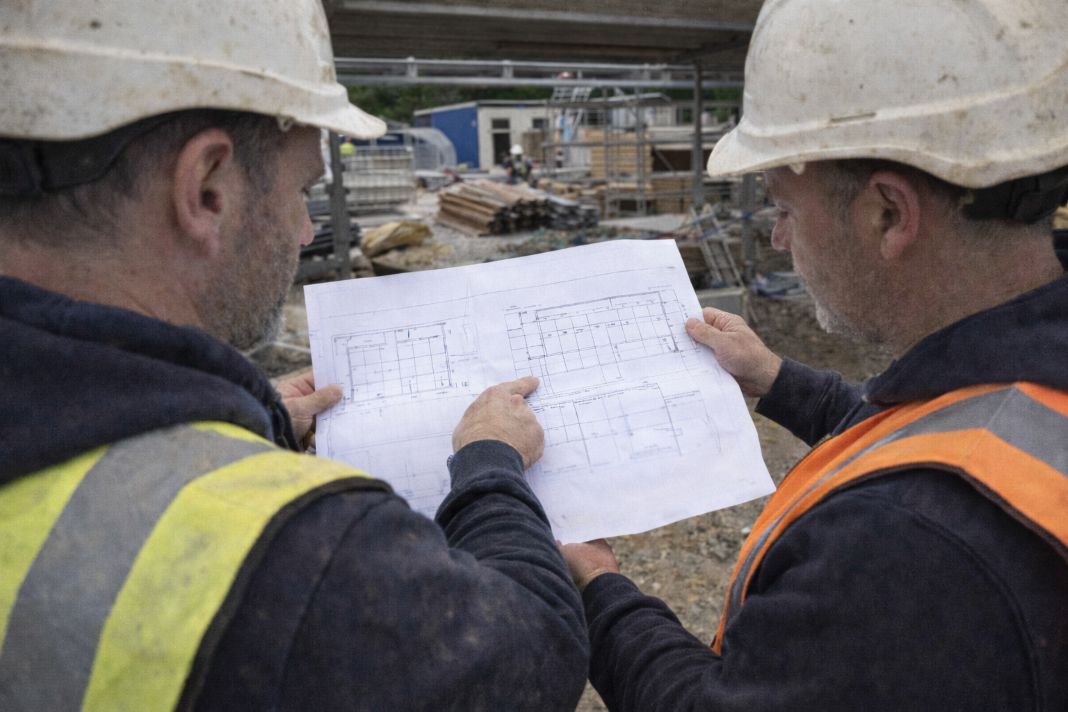
AI image of electrician on-site
Course content, assessment, and study logistics: what to expect
Most people complete these NVQs while they are already in work. That is because the assessment is based on real tasks carried out in a live construction environment.
A typical process looks like this:
- You are matched to the right Level 3 NVQ for your job role.
- An assessor explains the units, evidence requirements, and assessment plan.
- You gather workplace evidence, which may include photographs, site documents, job records, or witness testimony.
- The assessor observes you carrying out relevant duties on site.
- Your portfolio is reviewed until all units are met.
Evidence matters more than revision notes. For Interior Systems, that may include drawings, installation records, quality checks, and examples of completed work. For Occupational Work Supervision, it may involve work allocation records, toolbox talk evidence, planning documents, or records linked to site coordination.
Timeframes vary because they depend on your role, your current workload, and how quickly suitable evidence can be gathered. Someone already performing the right duties consistently may move through the process faster than a worker whose job only occasionally covers the required tasks.
Employers often play a part. Site access for observations, support with documents, and confirmation of your responsibilities can make the process much smoother. If your role title says one thing but your real duties show a higher level of responsibility, that evidence becomes especially important.
MOS Training Centre delivers construction NVQs through on-site assessment across the UK, which means learners do not need to attend a centre in Loughton for this route. That arrangement suits workers whose jobs are based on active sites and changing locations.
Costs, funding, and value: what you need to know
Current pricing for these Level 3 construction NVQs is straightforward. The Level 3 NVQ Diploma fee is £980.
That usually covers the qualification and assessment process, although any provider should explain clearly what is included before enrolment. A reader comparing options should always look for transparency on assessment support, evidence review, and any added charges.
Funding and support can come from several directions:
- employer payment, especially where the qualification supports site card requirements or supervisory progression
- workforce training budgets within contractors or subcontractors
- self-funding by individuals who want formal recognition and a stronger route into higher-responsibility roles
Pay progression is often part of the conversation, but it should be treated sensibly. A Level 3 NVQ does not guarantee a pay rise by itself. What it can do is strengthen your position for roles where formal qualifications, card eligibility, and recognised competence are expected. In practical terms, that can widen the jobs you can apply for and support a move into better-paid supervisory work when the role is right.
Start Your NVQ Application
Begin your Level 3 NVQ in Interior Systems or Work Supervision with a straightforward on-site assessment process.
CSCS cards, compliance, and site access: what changes with Level 3?
The Construction Skills Certification Scheme, usually shortened to CSCS, links qualifications to card types used across much of the UK construction industry. For many workers, that connection is one of the main reasons to take a Level 3 NVQ.
In broad terms, the qualification can affect card eligibility in these ways:
- Level 3 Interior Systems may support eligibility for a CSCS Gold Card linked to advanced craft status, where the qualification matches the occupation.
- Level 3 Occupational Work Supervision is commonly linked to the CSCS Gold Supervisor Card.
- Site access may improve where clients or contractors expect the card to match your actual duties.
Rules are becoming tighter on many projects because contractors want card types that reflect genuine competence and responsibility. A labourer card or basic skilled worker card may no longer fit if you are already leading others or carrying out advanced specialist work.
Renewal also causes confusion. Holding a card now does not always mean renewal will be straightforward later if your qualification record does not match the card category. A worker who leaves this until the last minute can end up dealing with avoidable delays just as a new job starts.
CSCS requirements can vary by employer and contract, so it is sensible to confirm which qualification and card align with your present role before starting the NVQ.
Common misconceptions and mistakes: what trips people up
The most common problem is assuming on-site assessment means little effort is required. It does not. The work is based on your real job, but you still need organised evidence and assessor input.
Several issues come up again and again:
- People choose the wrong NVQ level for their actual duties. A strong installer is not always a supervisor, and a supervisor may need more than a trade-focused award.
- Candidates underestimate the amount of evidence needed. Good site photos alone are rarely enough without supporting records and observations.
- Some workers think experience automatically equals qualification. Experience matters, but it still has to be assessed properly.
- Employer cooperation is left too late. If access to documents or witness statements becomes difficult, the process can slow down.
- Time is misjudged. A busy site schedule can make evidence gathering uneven, especially if your work changes from week to week.
A practical way to avoid delays is to treat the NVQ like a live project file. Keep records as you go, save relevant documents early, and respond to assessor requests promptly. Small gaps in a portfolio can hold things up longer than most people expect.
The UK construction landscape: skills shortages and future demand
Construction remains one of the UK’s biggest employment sectors, with around 2.1 million people working across the industry. CITB has also pointed to the need for a substantial number of additional workers over the coming years, which places more attention on training, upskilling, and verified competence.
That wider picture matters because sites are under pressure to deliver safely, on programme, and to a high standard. Employers need people who can do the work and prove they can do it. Formal qualifications fit directly into that shift.
Interior systems specialists are part of a section of the industry where sequencing, finish quality, fire performance, acoustic standards, and coordination with other trades can all affect the end product. Supervisors are equally important because programme pressure can expose weak planning and poor communication very quickly on live projects.
Experience still counts for a great deal. Even so, the direction of travel is clear. Qualifications, card alignment, and evidence of competence are becoming more important across the UK construction industry, especially for workers who want long-term progression.
Preparing for success: what to have in place before you start
Before beginning a Level 3 NVQ, it helps to have the basics lined up. That makes the assessment smoother and gives you a clearer idea of whether the qualification matches your current role.
- Check that your daily duties genuinely fit the NVQ. Interior Systems suits advanced trade work in areas such as drylining and ceilings, whereas Occupational Work Supervision suits active supervisory responsibility.
- Make sure you have enough current site experience. The assessment relies on live evidence from real work.
- Speak to your employer or workplace supervisor. Their support may be needed for observations, documents, and witness testimony.
- Start gathering records early, including drawings, job sheets, quality checks, or supervision notes that reflect what you actually do.
- Set realistic expectations for time. Even an experienced worker needs space to organise evidence and complete the process properly.
A bit of preparation at the start often makes the difference between a smooth assessment and a stop-start one that drags on longer than necessary.
Looking ahead: the lasting value of a Level 3 NVQ in Interior Systems or Work Supervision
A Level 3 NVQ does something simple but important. It turns day-to-day site ability into recognised professional standing.
For interior systems specialists, that can mean stronger career progression within a technical trade. For supervisors, it can mean formal recognition of responsibilities they are already carrying out on site. In both cases, the qualification gives structure to experience and makes it easier to show employers, contractors, and clients where you fit.
Construction does not stand still. Roles shift, compliance expectations tighten, and card requirements change over time. Workers with recognised qualifications are usually in a better position to adapt, whether they want to move up, move across to a new employer, or take on broader responsibilities later in their career.
Experience opens the door, but recognised competence often decides how far that door stays open.