
How much do you actually need to budget to become a fully qualified electrician in the UK?
For most people, the cost of becoming a fully qualified electrician in the UK sits somewhere between roughly £2,000 and £4,500 in training fees, depending on experience, the route chosen, and any extra costs such as travel, books, equipment, and resits. A new entrant usually pays more because they need a full training pathway, whereas an experienced electrical worker may only need the final qualifications that confirm existing competence.
Here's What We Have Covered In This Article
The Direct Cost of Becoming a Fully Qualified Electrician in the UK
In UK industry terms, “fully qualified” usually means holding the core qualifications needed to prove occupational competence, often including technical training, an NVQ, and current wiring regulations knowledge. For many electricians, that also links to JIB grading and the practical ability to work across a wider range of jobs and contracts.
Current training fees vary by route. Typical examples include:
- City & Guilds Level 3 Technical Occupational Entry in Electrical Installations (2366-03): £2,560
- City & Guilds Level 3 NVQ Diploma in Electrotechnical Technology (2357): £1,600
- City & Guilds Level 3 Electrotechnical Experienced Worker Qualification (2346-03): £1,600
- City & Guilds Level 3 Award in Requirements for Electrical Installations BS 7671:2018, often called the 18th Edition (2382-22): £392
- City & Guilds Initial and Periodic Inspection and Testing (2391-52): £1,200
- EAL Level 3 Award in Building Regulations for Electrical Installations in Dwellings: price varies by provider
- EAL Level 3 Award in In-Service Inspection and Testing of Electrical Equipment, often called PAT Testing: price varies by provider
A career starter taking the 2366-03 route and later adding the 2357 NVQ and 18th Edition could therefore spend around £4,552 in course fees alone. An experienced worker who already has the practical background may be able to complete the 2346-03 and 18th Edition for around £1,992, assuming no extra units are needed.
Additional expenses often sit outside the headline course price. Travel to an exam centre, revision materials, workwear, tools, registration fees, and resit charges can all add to the total. If your course includes centre attendance, location matters too. Someone travelling regularly into Essex or London may spend more overall than a learner completing most of their assessment on site or closer to home.
Pro Tip 1: Comparing total costs including travel, books, and time away from work will give you a more accurate training budget.
Who Needs to Know: Career Starters, Experienced Workers, and Employers
The right budget depends heavily on where you are starting from. Someone leaving another trade does not face the same costs as an approved electrician topping up missing qualifications.
Career starters and career changers usually need the longest route. They often begin with a Level 3 technical qualification, then move into workplace assessment and the NVQ once they are employed in the industry. That route costs more because it covers both knowledge and competence.
Experienced electrical workers often focus on the shortest legitimate route to formal recognition. If you have years of relevant site experience but lack the paperwork, the Experienced Worker Qualification may be the more suitable option. In that case, the main issue is usually proving competence through evidence and assessment, rather than starting from scratch.
Employers and training managers look at costs differently again. Their concern is often workforce upskilling, compliance, and getting staff qualified without pulling them away from productive work for long periods. A staged plan can matter more than the lowest upfront fee, especially where several electricians need training at once.
Some workers also need to consider related cards and grading. A CSCS card, which is the Construction Skills Certification Scheme card used on many sites, and JIB recognition may depend on the exact qualification pathway completed, so course price on its own never tells the full story.

AI image of electrician performing insulation test in workshop
Pro Tip 2: Proving your existing experience with detailed workplace evidence can shorten your qualification pathway and reduce costs.
Comparing the Main Qualification Routes and Their Costs
Several recognised routes can lead toward full electrician status, but they suit different backgrounds. The cheapest route on paper may be the wrong one if it does not match your current experience.
Here is a straightforward comparison of the main options:
- New entrant route: City & Guilds 2366-03, then workplace experience, then 2357 NVQ, often with 18th Edition added. This route suits beginners and career changers. Fees are usually highest because it covers the full training pathway.
- Experienced worker route: City & Guilds 2346-03, usually with 18th Edition if not already held. This route suits workers with substantial industry experience who need formal recognition. Fees are lower than a full new entrant route, but evidence demands are higher.
- NVQ top-up route: 2357 NVQ for people who already hold the technical knowledge qualification and are working in the trade. This route can be cost-effective if earlier study has already been completed.
- Specialist short courses: 18th Edition, 2391, PAT Testing, or Building Regulations. These do not usually make someone fully qualified on their own, but they can be necessary additions for employability and compliance.
Awarding body names matter, although they do not automatically change the route itself. City & Guilds and EAL are both recognised awarding bodies in electrical training. The right choice depends more on the qualification required for your job goal than on the badge on the certificate.
MOS Training Centre delivers City & Guilds electrical qualifications from its training centre in Loughton, Essex. That matters mainly for learners who need in-person exams or assessments within reach of London and the South East.
A common misunderstanding is that a fast-track electrician course always means lower cost. In practice, a shorter route is only suitable if your experience already covers the missing ground. If it does not, the lower fee can turn into wasted money because you still need to go back and complete the correct qualifications later.
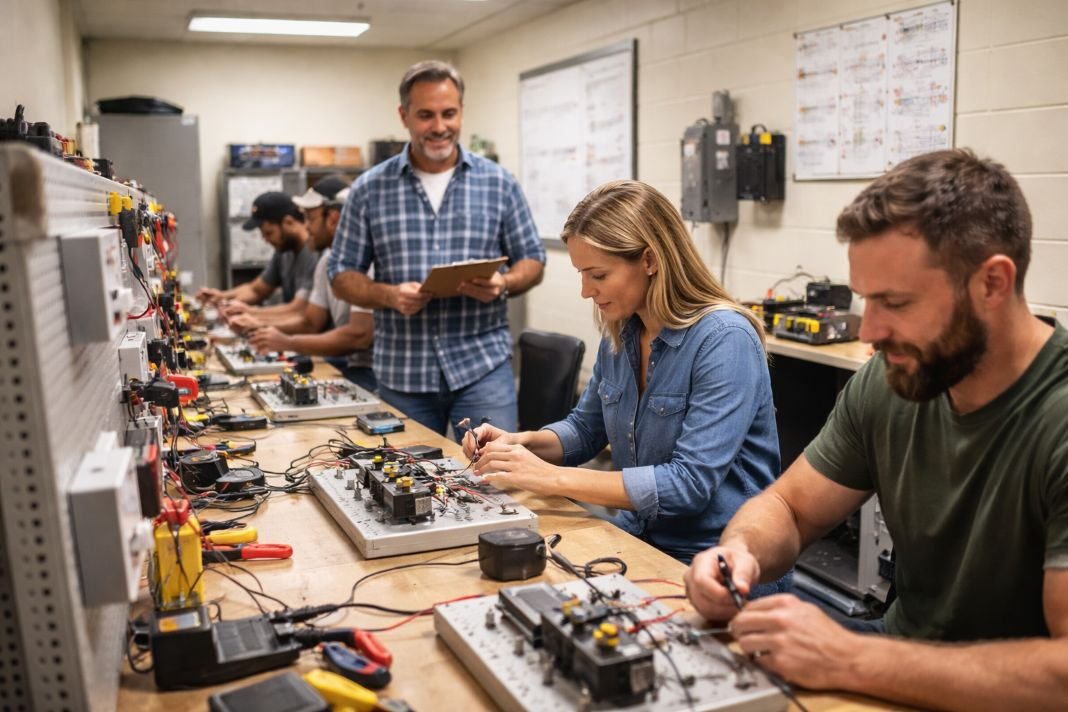
AI image of learning documentation and students in classroom
What’s Involved: Course Content, Assessment, and Duration
Course fees make more sense once you know what they pay for. Some qualifications focus on technical knowledge, some on workplace competence, and some on current regulations.
A technical course such as the City & Guilds 2366-03 usually covers electrical principles, installation practice, inspection basics, and health and safety. Assessment often includes written exams and practical tasks. Learners who are new to the trade usually need more time here because they are building knowledge before they can prove competence on site.
An NVQ, or National Vocational Qualification, works differently. It is based on evidence of what you do at work, which means that assessment is linked to real tasks, workplace observation, and a portfolio. That route suits people already employed in electrical installation because they need access to live jobs and evidence from actual work.
The Experienced Worker Qualification sits somewhere between a full beginner route and a simple top-up. It is for people with substantial site experience but without the complete formal qualification record. Evidence still matters, and the standard expected is high, because the assessment is meant to confirm competence rather than teach the trade from the beginning.
The 18th Edition course is usually shorter and focuses on BS 7671:2018, the wiring regulations standard used across UK electrical work. Inspection and Testing, often called 2391, adds another layer by covering the knowledge and assessment needed for initial verification and periodic inspection work.
Timeframes vary. A short regulations course may be completed quickly, whereas a full route from beginner to occupational competence can take much longer because workplace experience has to be gained as well as assessed. Centre-based exams for electrical qualifications are often taken in person, and learners in Essex or London may attend a venue such as the Loughton centre used by MOS Training Centre.
What Does Becoming Fully Qualified Lead To?
Becoming fully qualified opens access to a broader range of electrical work and gives formal proof of competence that clients, employers, and contractors recognise. It can also affect which cards, grading routes, and contracts are realistically open to you.
For many electricians, the practical outcomes include site access, stronger employability, and a clearer route into JIB registration or grading. Employers often want evidence that a worker meets current industry standards, especially for inspection, testing, domestic compliance, or commercial installation roles.
You may also be better placed to apply for the ECS card used in the electrotechnical sector, alongside any site-specific CSCS requirements where relevant. Card and grading rules can vary by role and employer, so the qualification route needs to match the work you intend to do.
Further progression can follow later. Once the core route is in place, electricians often add 2391, PAT Testing, domestic building regulations knowledge, or specialist skills linked to areas such as EV charging and renewable energy systems. That progression tends to grow from a solid base, not from collecting unrelated short courses.
Book a Free Consultation
Discuss your qualification options and costs with an expert team member at MOS Training Centre.
Common Cost-Related Mistakes and Misconceptions
Plenty of confusion around electrician training costs comes from comparing prices without comparing outcomes. A low fee is not much use if it does not move you closer to recognised electrician status.
- Assuming the course fee is the full cost. Travel, books, exam resits, lost work time, and equipment can push the real figure higher than expected.
- Choosing a beginner route despite already having years of experience. An experienced worker may be better suited to the 2346-03 route, which can reduce unnecessary study and duplicated cost.
- Choosing an experienced worker route without the evidence to support it. That can lead to delays, extra assessment time, or the need to complete further learning first.
- Believing that the 18th Edition alone makes you fully qualified. It is an important qualification, but on its own it does not replace the technical and competence-based elements of the full pathway.
- Ignoring employer support. Some companies pay in full, fund part of the cost, or spread fees across stages where the qualification supports business needs.
- Treating speed as the main goal. A route that fits your background properly is usually better value than one that simply looks quick on a course page.
One of the most expensive mistakes is paying for several short courses in the hope that they will somehow add up to full qualification. In most cases, the industry still wants to see the right core pathway completed in the right order.
The UK Industry Context: Skills Shortages, Demand, and Regulation
The cost of electrician training sits within a wider labour market that still needs qualified people. Demand has been pushed by general construction activity, compliance expectations, refurbishment work, and growing interest in low-carbon technologies.
The UK construction industry employs around 2.1 million people, and industry forecasts have pointed to substantial additional labour needs over the next few years. Electrical work sits within that picture, with further demand linked to EV charging, renewable systems, testing, and upgrades to existing buildings.
Formal qualifications also matter more because site and contract requirements have tightened over time. Proof of competence, current regulations knowledge, and recognised assessment routes now carry more weight than informal experience alone. JIB grading and site access standards reflect that shift.
Regional patterns add another layer. London and Essex continue to generate demand across commercial, domestic, and infrastructure work, yet the same qualification issues apply nationwide. Someone based far from a training centre may need to budget differently for travel, but the underlying need for recognised electrical qualifications remains much the same.
Preparing for Your Training Process: Practical Checklist
A bit of planning can save both money and frustration before you enrol on any electrical course.
- Work out whether you are a beginner, an improver, or an experienced worker with evidence already in place.
- Check which qualification is actually required for your target role, JIB grading route, or site card.
- Add up the full budget, including course fees, travel, revision materials, work time lost, and possible resits.
- Confirm how assessment works, especially if the route includes workplace evidence or an NVQ portfolio.
- Review your current certificates so you do not pay twice for learning you have already completed.
- Make sure you can access suitable electrical work if your route depends on on-site evidence.
- Plan your study time realistically if you are balancing training with full-time employment.
- Ask your employer whether they offer funding, staged payment support, or paid time for assessment.
A clear budget and the right route at the start usually matter more than chasing the cheapest advertised figure.
Looking Beyond the Price Tag: The Real Value of Qualification
Training fees are easy to measure, but the value of qualification sits in what those fees make possible over time. A recognised route gives structure to your career, supports formal recognition, and puts your skills on record in a way the industry understands.
That matters in a market where electrical work keeps changing. New technologies, updated standards, and tighter compliance expectations all favour people whose training is current and properly assessed. A certificate on its own is never the full story, but accredited qualifications from bodies such as City & Guilds, EAL, and the NVQ framework carry weight because they connect knowledge with proven competence.
Anyone budgeting for electrician training should therefore look at two figures, not one. The first is the fee you pay now. The second is the cost of delay, repetition, or choosing the wrong route and having to start again later.