
Do you need a CSCS or ECS card to work in UK construction?
It depends on your trade. The CSCS card is commonly used across UK construction sites to show that you understand health and safety and meet the minimum standard to work on site. The ECS card is more specific and is used to prove your qualifications in electrical or electrotechnical roles. These two cards are not interchangeable. Having the correct construction site access card for your job avoids delays, missed work, and site entry problems.
Here's What We Have Covered In This Article
What Is a CSCS Card and Who Needs One?
The CSCS card, managed by CSCS Ltd and supported by the Construction Leadership Council, confirms that you’ve passed a health and safety test and meet qualifications for your trade. It serves as proof that you’re job ready and compliant with basic health and safety awareness on site.
CSCS cards are typically used by general labourers, decorators, site supervisors, groundworkers, and plant operators.
Common CSCS Card Trades:
-
General labourer (CSCS Green Card for general site access)
-
Bricklayer (CSCS Blue or Gold Skilled Worker Card)
-
Plasterer
-
Painter and decorator
-
Plant machinery operator
-
Site supervisor
To apply for a CSCS card:
-
Pass the CITB Health, Safety and Environment Test
-
Hold a recognised NVQ or SVQ depending on your trade
The Green Labourer Card is the most widely used and is valid for five years. Skilled Worker cards are issued to those with higher-level qualifications.
Pro Tip 1: If you’re waiting on your NVQ, apply for a Trainee Card so you can still access site work legally.

What Does the ECS Card Cover and How Is It Different?
The ECS card is part of the Electrotechnical Certification Scheme, overseen by the Joint Industry Board. It confirms your electrical competence and verifies your understanding of health and safety in the electrotechnical environment.
ECS cards are the industry standard for electricians and related technicians.
ECS Card Job Roles:
- Electrician (ECS Gold Card – Skilled Worker level)
- Fire and security system technician
- Data cabling installer
- Audio visual installer
To qualify for an ECS card:
- Pass the ECS Health, Safety and Environmental Assessment
- Hold an NVQ Level 3 in electrotechnical installation
- Be registered with a recognised organisation such as NICEIC or ECA
You may also apply for JIB grading to reflect your experience and trade level.
How to Know Which Card You Need for Your Trade
Some multi-skilled trades may require both cards. If you are unsure, speak to your site supervisor or employer before booking any tests.
The card you need depends on the work you do. Here’s a quick comparison:
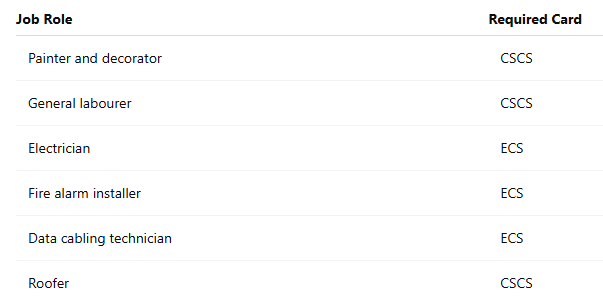
Pro Tip 2: Always double-check if the job requires ECS—even for basic installs like data cabling.
CSCS Card Application:
-
Pass the CITB Health, Safety and Environment Test
-
Hold an NVQ Level 1, 2 or 3 for your trade
-
Provide valid photo identification
ECS Card Application:
-
Pass the ECS Health, Safety and Environmental Assessment
-
Hold an NVQ Level 3 in electrotechnical installation
-
Be registered with a training centre or approved employer
-
Apply for JIB grading if needed
These requirements confirm your skill level and your health and safety awareness. Both cards act as job-ready proof for entering a construction site legally.
Can You Hold Both Cards or Switch Between Them?
Yes. Workers who carry out both electrical and general construction tasks may need to hold both ECS and CSCS cards. This is common for:
-
Fire alarm engineers who also mount equipment or fixtures
-
Site supervisors overseeing mixed teams
-
Multi-skilled workers doing cabling and site setup work
Switching Between Cards
You may switch from CSCS to ECS by completing an NVQ Level 3 in electrical installation and passing the ECS HSE test. Sites will not accept CSCS cards as proof of electrical competence.
What Happens If You Bring the Wrong Card to Site?
Most sites now use verification tools such as the CSCS Smart Check app or the ECS Card Checker. These check whether your card is active, valid, and linked to your current trade.
What can go wrong:
-
Entry to site is refused
-
Site induction process is delayed
-
You lose a day’s wages
Avoid problems by checking:
-
Your card is in date
-
The role matches your card type
-
You’ve taken the correct safety test for the job
Do Career Changers and Apprentices Need ECS or CSCS?
Yes. New entrants and career switchers are expected to hold a valid card.
Use a CSCS card if:
-
You are starting a non-electrical apprenticeship
-
You are working as a general labourer or site support
Use an ECS card if:
-
You are training to become an electrician
-
You are an apprentice in data cabling, fire alarm systems or smart technology
Both schemes offer Trainee Cards that let you work while completing your qualifications. You’ll need proof of enrolment in a recognised course.
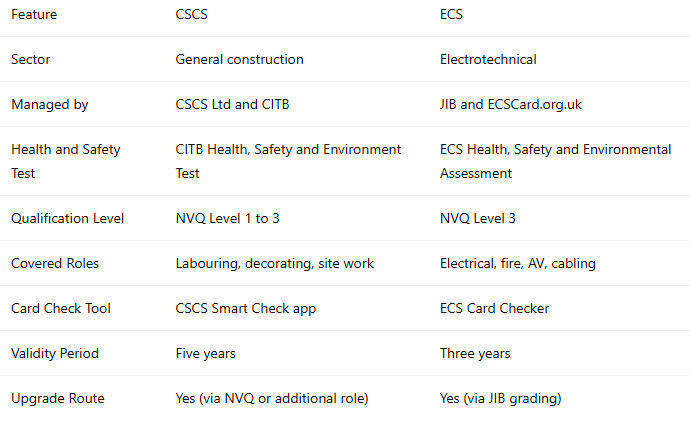
CSCS vs ECS Card Comparison Table
Mistakes to Avoid When Applying
Before you book your test or apply for a card, double-check these common pitfalls that could delay your site access:
- Booking the wrong test type (e.g. CITB HS and E instead of ECS HSE for electrical roles)
- Choosing a card that doesn’t match your actual site duties
- Using an expired NVQ certificate or one not aligned with your card level
- Applying without checking if your employer or site accepts the card for your trade
- Forgetting to bring valid ID or documentation to your test centre
These small mistakes can result in rejected applications or site refusal. A quick check beforehand can save time and hassle.
Final Guidance: Choose the Right Card with Confidence
Whether you’re a first-time applicant or returning to the trade, the correct site card ensures quicker access, better job matches and fewer site delays.
Where to Get Help:
- Go Construct: Guides for trade roles
- CSCS.uk.com: Application process and card checker
- ECSCard.org.uk: Apply for ECS, check card status
- JIB.org.uk: Information on grading, pay bands and career paths
If in doubt, ask your employer, tutor or a training centre before applying.
Use the right card. Get on site faster. Stay compliant and job ready.
Frequently Asked Questions (FAQ)
Q: Can I apply for a CSCS card without an NVQ?
A: Yes, some provisional and trainee CSCS cards are available while you work towards your NVQ. However, they are limited to supervised roles and are usually valid for six to twelve months.
Q: What’s the difference between the CSCS test and the ECS test?
A: The CSCS test is managed by CITB and covers general construction safety. The ECS test is tailored for the electrotechnical industry and includes sector-specific safety knowledge.
Q: How long does it take to get a CSCS or ECS card?
A: After passing your test and submitting valid documents, most cards are issued within 7 to 10 working days. Some delays may occur if extra verification is required.
Q: Do I need to renew my card?
A: Yes. Most CSCS cards are valid for five years, and ECS cards typically expire after three. Renewal requires proof of updated qualifications or a retest.
Q: Can I work on site while waiting for my card?
A: Some employers allow access with test confirmation and ID, but many require the physical card or digital verification. Always confirm in advance.
Book Your CITB or ECS Test Today
Need your card fast? Book your health and safety test with our support and avoid delays.